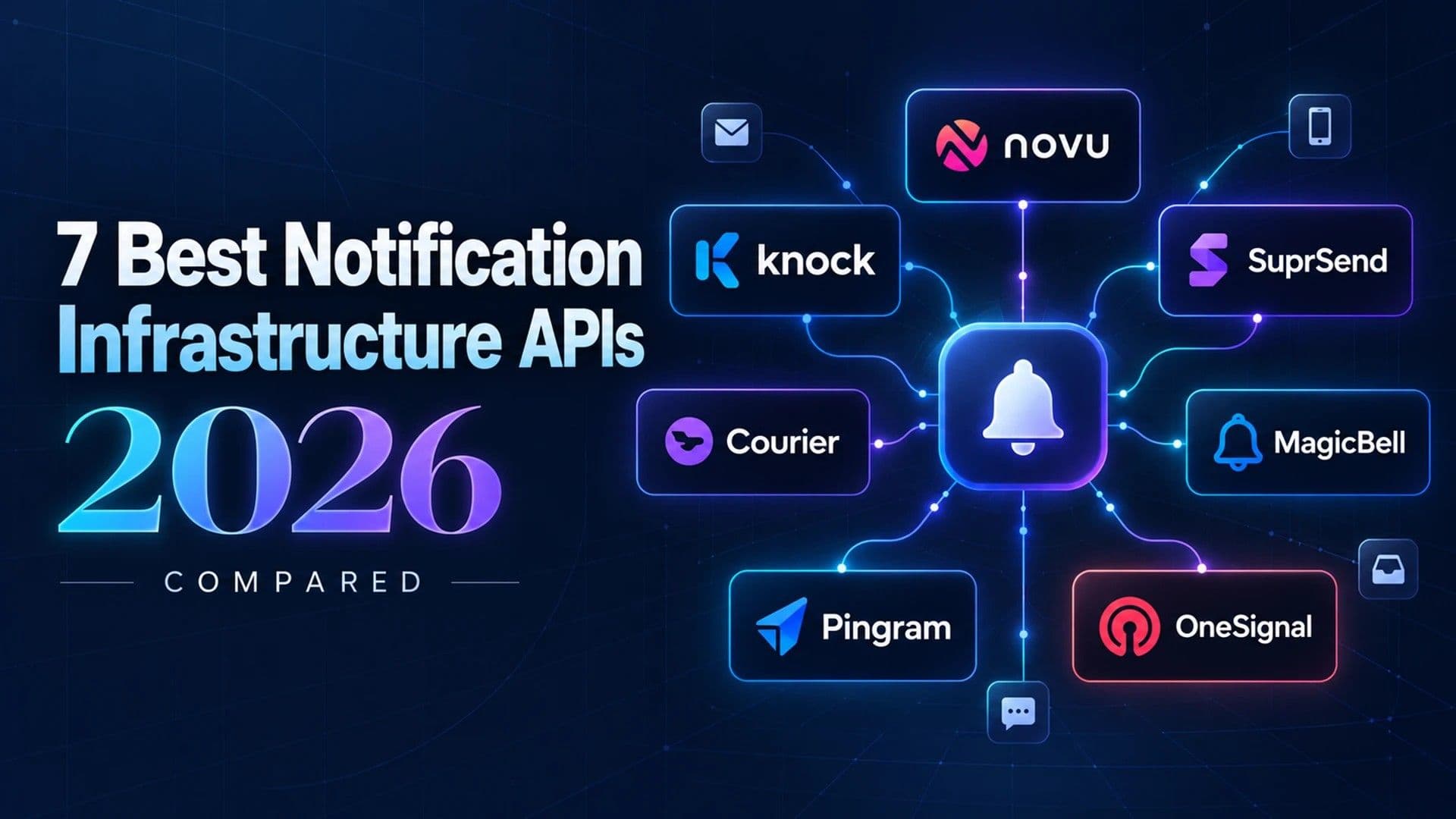
7 Best Notification Infrastructure APIs in 2026 (Compared)
7 Best Notification Infrastructure APIs in 2026 (Compared)
APIRest ApiSaaSNotifications
Every SaaS product ends up building the same notification system twice.
The first version is a send_email() call inside a controller. The second one arrives six months later, when users ask for an in-app inbox, a "daily digest instead of 40 emails" setting, and a way to mute Slack alerts without muting everything.
If you're:
adding an in-app inbox to your product,
replacing a pile of email, SMS and push calls with one API,
or choosing between Knock, Novu and Courier,
this comparison is for you.
Short answer: pick Knock if you want the most polished developer experience with digests on the free plan. Pick Novu if you want open source (MIT) and the lowest bill. Pick SuprSend if you need WhatsApp and the widest channel list. Pick Courier if your app is mobile-first and you want inbox SDKs for iOS, Android and Flutter.
How this comparison was made: this edition is based on each vendor's official docs and pricing pages, checked on October 31, 2026. I didn't run hands-on tests for this edition, so there are no latency or deliverability numbers here, only what each vendor documents publicly. Anything I couldn't confirm in the docs is marked as "not confirmed" instead of guessed.
What notification infrastructure actually does
A notification infrastructure platform sits between your backend and the channels your users read. Your code fires one event () and the platform decides the rest:
new_comment
Routing: which channels this user gets (in-app, email, push, SMS, Slack).
Batching: whether 10 comments in 2 minutes become 10 emails or one digest.
Preferences: whether this user muted email for this category.
It does not replace your email or SMS provider. Most of these platforms still send through Resend, SES, Mailgun, Mailtrap or Twilio, which you pay for separately. Pingram is the exception in this list.
That's the part most pricing pages don't tell you.
*Workload: 50,000 events/month, each delivered to in-app + email (100,000 channel messages). List prices, checked 2026-10-31. Doesn't include your email/SMS provider, except for Pingram. The Courier range depends on whether a multi-channel send counts once or once per channel; the pricing page doesn't say.**OneSignal is included as the reference most teams compare against, not as a like-for-like notification infrastructure platform.
Why "price per notification" is misleading
Look at the billing unit column again. Same workload, five different units:
Knock counts one message per user per channel.
SuprSend and MagicBell also count every channel separately.
Novu counts one workflow run, no matter how many channels it fans out to.
Courier counts a send.
So an in-app + email notification costs you 2 units on Knock, SuprSend and MagicBell, and 1 unit on Novu.
That's why Novu comes out 9× cheaper for this workload. It's not a discount. It's a different meter.
Here's the script I used, so you can plug in your own numbers:
# Monthly cost for the same workload (list prices, checked 2026-10-31)
EVENTS = 50_000          # events your backend fires per month
CHANNELS = 2             # in-app + email
MESSAGES = EVENTS * CHANNELS

def over(used, included, price_per_unit):
    return max(0, used - included) * price_per_unit

plans = {
    "Knock":     250 + over(MESSAGES, 50_000, 0.005),     # per message
    "Novu":      30 + over(EVENTS, 30_000, 1.20 / 1000),  # per workflow run
    "SuprSend":  250 + over(MESSAGES, 50_000, 5 / 1000),  # Business, includes digest
    "MagicBell": 249 + over(MESSAGES, 50_000, 0.0025),    # per delivery
}

for vendor, cost in plans.items():
    print(f"{vendor:<10} ${cost:,.0f}/mo")
Knock      $500/mo
Novu       $54/mo
SuprSend   $500/mo
MagicBell  $374/mo
Change CHANNELS to 3 (add push) and the gap gets wider. Change EVENTS to 5,000 and almost everyone fits in the free tier.
1. Knock: the most complete developer experience
Knock is a notification infrastructure platform built around workflows: trigger one event, and Knock handles batching, preferences and delivery across email, in-app, push, SMS and chat (Slack, Microsoft Teams, Discord). It's a small team, 11–50 people according to its own pricing page, with $18M raised including a $12M Series A led by Craft Ventures.
Pros
Batching and digests are available on every plan, including Free. Most competitors gate this.
React components for Feed, Inbox, Toast and a Preferences UI, plus a hosted preference center.
MCP server (mcp.knock.app), CLI and an agent for building workflows from your editor.
SOC 2 Type 2 and GDPR on all plans. HIPAA BAA on Enterprise.
Cons
The jump from Free to Starter is $250/month minimum. No cheap middle tier.
Billed per message per channel, so multi-channel workflows add up fast.
No open source or self-hosted option found in the docs.
Best for: product teams that want digests, an in-app feed and a preference center working in a day, and can justify $250/month once they outgrow 10k messages.
2. Novu: the open source option (and the cheapest)
Novu is the only platform here with an open source core: MIT license on GitHub, 40.2k stars, with enterprise features under a separate commercial license. You can use Novu Cloud or self-host.
Pros
Billed per workflow run, not per channel: the cheapest option for multi-channel notifications ($54/month for our workload).
<Inbox /> and <Preferences /> React components, plus a digest engine.
Server SDKs for TypeScript, Python, Go, PHP, .NET, Java, Kotlin, Laravel and Ruby (the widest list here).
US + EU data residency on the free plan. SOC 2 Type II and ISO 27001.
Cons
Free plan activity feed retention is 24 hours (Pro: 7 days). Debugging last week's missing notification won't work on Free.
Free plan caps at 20 workflows and 3 team members.
Self-hosting the full enterprise feature set requires the Enterprise plan.
Best for: startups that want to keep costs low, need data residency in the EU, or want the option to self-host later.
3. SuprSend: the widest channel coverage
SuprSend covers the most channels in this list: email, SMS, WhatsApp, mobile push, web push, Slack, Microsoft Teams, in-app and outgoing webhooks. Its inbox ships in embeddable and headless versions, with client SDKs for JavaScript, React, React Native, Expo, Flutter, iOS and Android.
Pros
WhatsApp is a first-class channel, not a "coming soon".
Unlimited channels and team members even on the free plan.
Essentials plan at $100/month for 50k notifications is the cheapest paid entry in the per-channel group.
Each workspace picks a data region, including the EU.
Cons
Batching & Digest and User Preferences require the Business plan ($250/month). Essentials doesn't include them.
Free plan inbox shows SuprSend branding.
Docs list ISO 27001 as done, while the pricing page badge still says "In Progress". Ask before you rely on it.
Best for: B2C or emerging-market products where WhatsApp and SMS matter as much as email.
4. Courier: best for mobile-first apps
Courier is a managed notification platform with the broadest set of client inbox SDKs: web, iOS, Android, React Native and Flutter. Digests and batching live inside Journeys, Courier's workflow builder.
Pros
Pay-as-you-go Business plan at $0.005 per send with no monthly minimum shown.
In-app inbox and toasts for every major mobile framework.
MCP server (mcp.courier.com), CLI and agent skills on the free plan.
SOC 2 Type II, HIPAA and PCI DSS programs. EU data residency on Business.
Cons
No self-hosted or on-premise option ("managed cloud platform" only, per the docs).
The pricing page doesn't say whether one multi-channel send counts once or per channel.
Digests are built as Journey nodes, which is more setup than a single "batch" step.
Best for: mobile-first products that need the same inbox on iOS, Android and Flutter without building three UIs.
5. MagicBell: a web inbox first
MagicBell positions itself as "the notification inbox for web & mobile apps". Its strongest documented piece is the web inbox, with components for React, Preact, Svelte and plain Web Components. It also delivers to email, mobile push, web push, SMS, Slack and Teams.
Pros
Unlimited team members and users on every plan.
Inbox components for frameworks others skip (Preact, Svelte, Web Components).
Email through SES, Mailgun, SendGrid or any SMTP server.
Cons
The free plan includes only 1,000 deliveries/month, 10× less than the others.
Digests and a preference center are not confirmed in the docs.
Extra projects cost $99/month each on the Startup plan.
Best for: web apps (especially non-React stacks) that mainly need a good-looking notification bell.
6. Pingram (formerly NotificationAPI): sending included
Pingram works differently from the rest. Instead of routing through your own email and SMS providers, it sends the messages itself. You prepay a monthly budget and pay per message: $0.0005 per email and $0.01 per US SMS, carrier fees included.
Pros
No separate email or SMS provider to sign up for and manage.
The cheapest way to send email at volume: 50,000 emails ≈ $25.
SOC 2 Type 2 and GDPR on the free plan. US, EU and Canada regions, each with its own MCP endpoint.
SDKs for Node.js, Python, PHP, Go, C#, Java and Ruby.
Cons
No documented REST endpoints for user preferences, digests or listing an in-app feed.
WhatsApp is still "Soon".
It's closer to a messaging API than a full workflow engine.
Best for: early-stage SaaS teams whose notifications are mostly email and SMS and who don't want to manage a delivery provider yet.
7. OneSignal: the push-first reference
Many teams start with OneSignal for push and then ask whether it can be their whole notification system. It can cover email, mobile push, web push, SMS and in-app messages. But it has no persistent in-app inbox: OneSignal's in-app messages are banners, surveys and carousels pulled when the app starts, and they're mobile-only.
Pros
Mobile push is unlimited on the free plan, up to 1,000 MAU.
Growth plan starts at $19/month, with 20,000 free emails.
AI and MCP are included on the free plan.
Cons
No notification feed or inbox, which is the core feature of every other platform here.
Push is billed per monthly active user ($0.012 per MAU on Growth), so cost tracks your user base, not your notification volume.
In-app messages don't work on the web.
Best for: mobile apps whose main channel is push and that don't need an inbox.
Build vs buy: when you don't need any of these
You probably don't need a notification infrastructure platform if:
you only send transactional email (password resets, receipts): an email API is enough,
you have one channel and no user preferences,
or you send fewer than a few hundred notifications a month.
You probably do need one when you add the second channel or the first digest. That's when the homemade version starts needing a queue, a preference table and a retry system.
How to choose the right notification infrastructure
Need open source or self-hosting? → Novu.
Want digests on the free plan and the best React components? → Knock.
WhatsApp and SMS are core channels? → SuprSend.
Mobile-first, inbox on iOS, Android and Flutter? → Courier.
Mostly email and SMS, no provider yet? → Pingram.
Mostly push, no inbox? → OneSignal.
Web app that mainly needs a notification bell? → MagicBell.
FAQs
❓ What is notification infrastructure?
✅ It's a platform that takes one event from your backend and handles routing, batching, user preferences and delivery across channels like email, in-app, push, SMS and Slack. You keep one API call instead of one integration per channel.
❓ Knock vs Novu: which one is better?
✅ Knock has digests on every plan and a polished set of React components, but its first paid plan starts at $250/month. Novu is open source (MIT core), bills per workflow run instead of per channel, and starts at $30/month. For multi-channel workloads, Novu is much cheaper.
❓ What are the best Novu alternatives?
✅ Knock (best developer experience), SuprSend (most channels, including WhatsApp) and Courier (best mobile inbox SDKs). None of them are open source, so if self-hosting is the reason you picked Novu, there's no direct alternative in this list.
❓ Is there an open source notification infrastructure?
✅ Yes. Novu's core is MIT-licensed and self-hostable. SuprSend offers self-hosting and bring-your-own-cloud only on its Enterprise plan, and it isn't open source.
❓ Do I still need an email provider like SendGrid or Resend?
✅ For Knock, Novu, SuprSend, Courier and MagicBell, yes: they route through a provider you connect. Pingram is the exception in this list, since it sends email and SMS itself.
❓ Which notification API has a free tier?
✅ All seven. Knock (10,000 messages), Novu (10,000 workflow runs), SuprSend (10,000 notifications) and Courier (10,000 sends) have the biggest free tiers. MagicBell's free plan includes 1,000 deliveries.
Final thoughts
The notification API you pick matters less than the billing unit behind it.
Count your events, count your channels, and run the numbers before the free tier runs out. The cheapest platform on the pricing page can be the most expensive one on your invoice.
Are you a vendor in this space? This list is updated every quarter with new pricing and new platforms. If your notification infrastructure product should be here, or something above is out of date, get in touch.