What Does a Browser Agent Actually Cost?

My n8n workflow said the run cost $0.0065.
The full bill was $0.0161, two and a half times that.
Not because anyone hid anything. A browser agent runs on three meters, and most tools only show you one of them: the model. The browser and, above all, the proxy traffic are billed separately, and on the wrong page they're most of the bill.
If you're:
- pricing a product that runs browser agents for customers,
- moving a scraper or a workflow to an agent and want to know the monthly cost,
- or staring at a usage dashboard that doesn't match what your code reported,
This breakdown is for you.
I ran 15 sessions on Browser Use Cloud on November 18, 2026: three tasks, four models, proxy on and off. Then I read the full cost of every session from the API. All numbers below come from those runs.
TL;DR
- Range: the same kind of work cost from $0.0024 to $0.164 per run, almost a 70× spread
- Proxy: on a heavy page (21 MB) the residential proxy was up to 94% of the bill. Turning it off cut that run from $0.109 to $0.0098, with the same answer
- Model: BU 4.0, the new default, cost 7.5 to 15.5 times more in model fees than gpt-6-luna on the same tasks, with the same answers
- Browser time: a rounding error, $0.001 to $0.0013 per session
- Gotcha: read the cost after the browser closes. Right after the run, every session showed a $0.08 browser line that later settled to about $0.001
The three meters
Every Browser Use session is billed on three lines. These are the prices on the pricing page and in the docs, read on November 18, 2026:
| Meter | Price | What drives it |
|---|---|---|
| Model (LLM) | Per million tokens, from $0.12 in / $0.60 out (gpt-6-luna) to $1.80 / $9.00 (BU 4.0) and up | Number of steps and how much of the page the agent reads |
| Proxy traffic | $5 per GB through the managed residential proxy, $0.20 per GB direct (proxy off) | How heavy the pages are |
| Browser time | $0.06 per hour, billed by the minute, 1-minute minimum | How long the browser stays open |
New accounts get a $1 credit, and credits are bought from $5. Since November 16, 2026, new projects default to BU 4.0. Older projects defaulted to gpt-6-luna, about 15 times cheaper per token.
The trap: "totalCostUsd" means two different things
When a run finishes, Browser Use returns a totalCostUsd. In my n8n tutorial I quoted that number. It's real, but the billing docs are explicit: a run's totalCostUsd is its LLM and web-search charge only.
The full bill lives on the session:
curl https://api.browser-use.com/api/v4/sessions/SESSION_ID/cost \
  -H "X-Browser-Use-API-Key: YOUR_API_KEY"
{
  "numRuns": 1,
  "llmCostUsd": "0.012437",
  "browserCostUsd": "0.001667",
  "proxyCostUsd": "0.013567",
  "proxyUsedMb": "2.778537",
  "totalCostUsd": "0.027671"
}
That's a real session from my n8n workflow. The run reported $0.0124. The session cost $0.0277. Across the five runs from that tutorial, the session total was 2.2 to 3.9 times what the run reported, and proxy traffic was 49% to 69% of it.
Same field name, two scopes. If you budget from the run's number, you'll undercount.
The test
Three tasks, chosen to stress different meters:
- A, light page: the top 5 stories on Hacker News, a small HTML page.
- B, heavy page: the top 5 on a Product Hunt daily leaderboard, a JavaScript-heavy page that showed me a Cloudflare check when I opened it in an ordinary automated browser.
- C, multi-step: on the browser-use GitHub repo, find the latest release and the open issue count. Two pages, about 21 MB of traffic per session.
Each task ran on four models with the default US residential proxy: bu-4.0 (the new default), bu-4.0-mini, bu-ultrafast and gpt-6-luna. Then each task ran once more on gpt-6-luna with the proxy off (proxyCountryCode: null). Every run had a maxCostUsd cap of $0.30. None hit it.
For every session I read the cost endpoint twice: 20 seconds after the run finished, and again about four minutes later, after the browser had stopped.
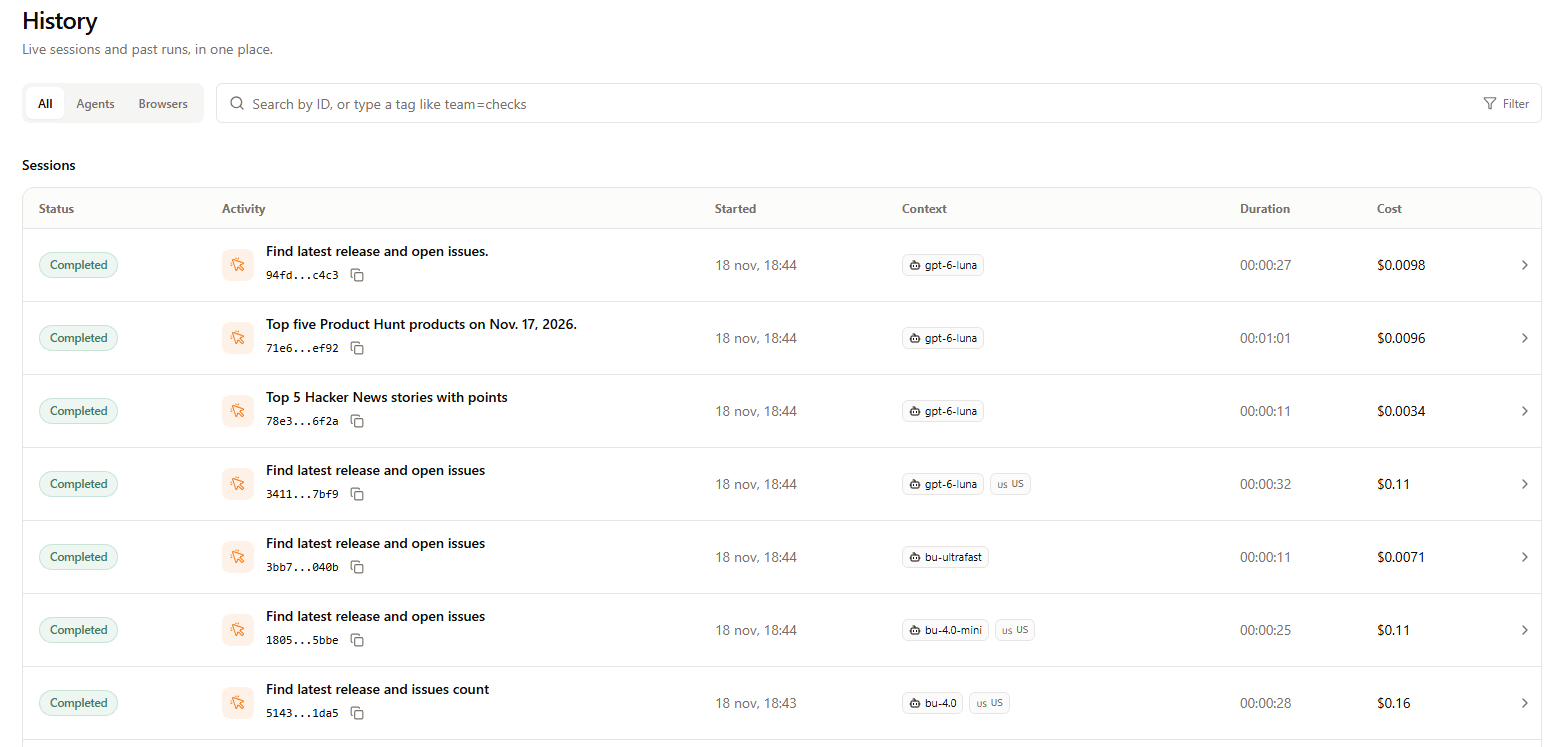
Here's part of the test as it shows up in the Browser Use dashboard. The us US tag marks the sessions that went through the residential proxy:
The results
Final costs, read after the browser stopped:
| Task | Model | Proxy | Steps | Model fee | Proxy (MB) | Browser | Total |
|---|---|---|---|---|---|---|---|
| A light | bu-ultrafast | on | 2 | $0.0014 | $0.0000 (0.02) | $0.0010 | $0.0024 |
| A light | gpt-6-luna | off | 3 | $0.0024 | $0.0000 (0.02) | $0.0010 | $0.0034 |
| A light | gpt-6-luna | on | 3 | $0.0024 | $0.0002 (0.03) | $0.0013 | $0.0039 |
| A light | bu-4.0-mini | on | 3 | $0.0040 | $0.0002 (0.03) | $0.0013 | $0.0055 |
| A light | bu-4.0 | on | 4 | $0.0371 | $0.0002 (0.03) | $0.0013 | $0.0386 |
| B heavy | bu-ultrafast | on | 13 | $0.0054 | $0.0013 (6.78) | $0.0013 | $0.0081 ⚠️ |
| B heavy | gpt-6-luna | off | 11 | $0.0074 | $0.0009 (4.84) | $0.0013 | $0.0096 |
| B heavy | bu-4.0-mini | on | 5 | $0.0071 | $0.0083 (1.69) | $0.0013 | $0.0167 |
| B heavy | gpt-6-luna | on | 11 | $0.0080 | $0.0087 (1.79) | $0.0013 | $0.0181 |
| B heavy | bu-4.0 | on | 5 | $0.0602 | $0.0090 (1.84) | $0.0013 | $0.0705 |
| C multi-step | bu-ultrafast | on | 5 | $0.0020 | $0.0041 (20.99) | $0.0010 | $0.0071 |
| C multi-step | gpt-6-luna | off | 8 | $0.0043 | $0.0042 (21.46) | $0.0013 | $0.0098 |
| C multi-step | gpt-6-luna | on | 7 | $0.0047 | $0.1033 (21.15) | $0.0013 | $0.1093 |
| C multi-step | bu-4.0-mini | on | 7 | $0.0075 | $0.1036 (21.22) | $0.0010 | $0.1121 |
| C multi-step | bu-4.0 | on | 6 | $0.0569 | $0.1064 (21.79) | $0.0010 | $0.1643 |
⚠️ = wrong answer (see below). The whole test cost $0.58.
Every other configuration returned the same data for its task: the same five Hacker News stories, the same five Product Hunt products with the same vote counts (Creatify Max 425, RankSpot 435, TheBold 421, Appxiom 287, EkLine 268), and the same release (1.0.6) and issue count (172) on GitHub.
What actually moves the bill
1. Proxy traffic, on heavy pages
The GitHub task moved about 21 MB per session. Through the residential proxy, at $5 per GB, that's $0.10, between 65% and 94% of the bill depending on the model.
With the proxy off, the same 21 MB was billed at the direct rate, $0.20 per GB: $0.004. The session dropped from $0.1093 to $0.0098, 11 times cheaper, and returned the same answer.
On the light Hacker News page the proxy barely registered (0.03 MB). On Product Hunt, turning it off cut the run from $0.0181 to $0.0096, and the agent still read the right numbers.
The dashboard shows the same pattern over a month. Across all my Browser Use sessions in the last 30 days, proxy data was 94% of the browser-side spend and browser time 6%:
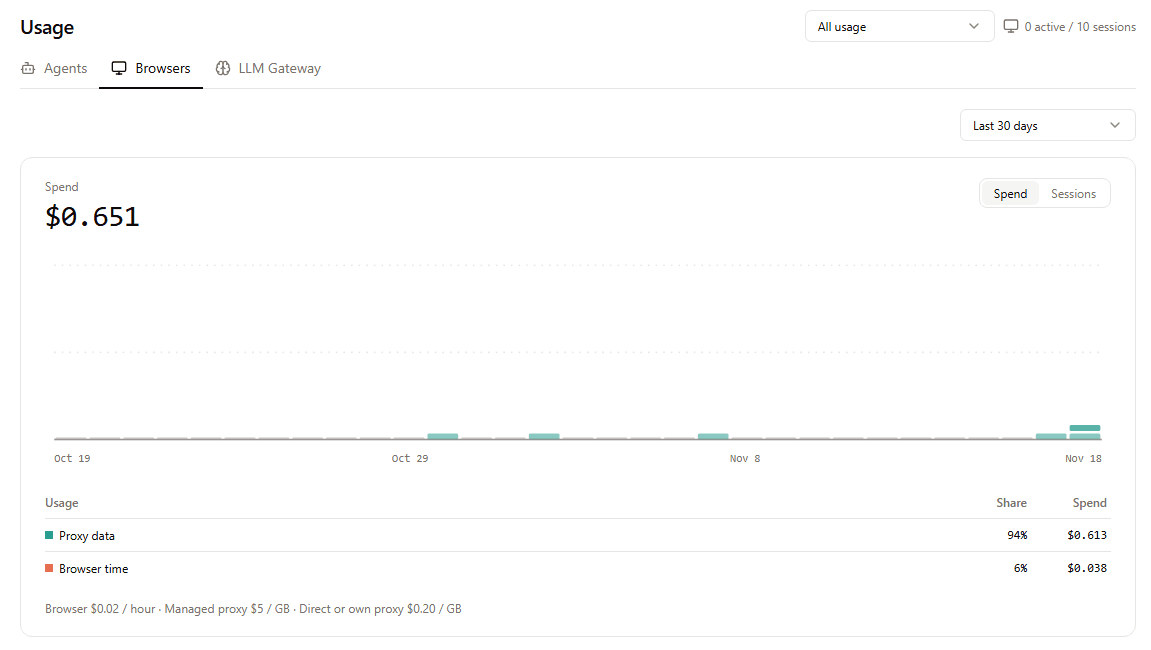
The footer on that screen lists browser time at $0.02 per hour. My sessions were billed $0.001 per minute, which is the $0.06 per hour on the pricing page.
The proxy exists for a reason: sites that block data-center traffic, and pages that change by country. Browser Use turns a US residential proxy on by default, and for many sites you need it. But it's a choice per task, not a tax you have to pay on every run. Test the site without it first.
2. The model
On the same three tasks, BU 4.0 spent $0.037, $0.060 and $0.057 in model fees. gpt-6-luna spent $0.0024, $0.0080 and $0.0047. That's 7.5 to 15.5 times more, for the same answers on these tasks. Against bu-4.0-mini the gap was 7.6 to 9.3 times.
The usage dashboard adds it up. BU 4.0 only ran in this test's three sessions: $0.154 in model fees. BU Mini's three sessions, on the same tasks: $0.019.
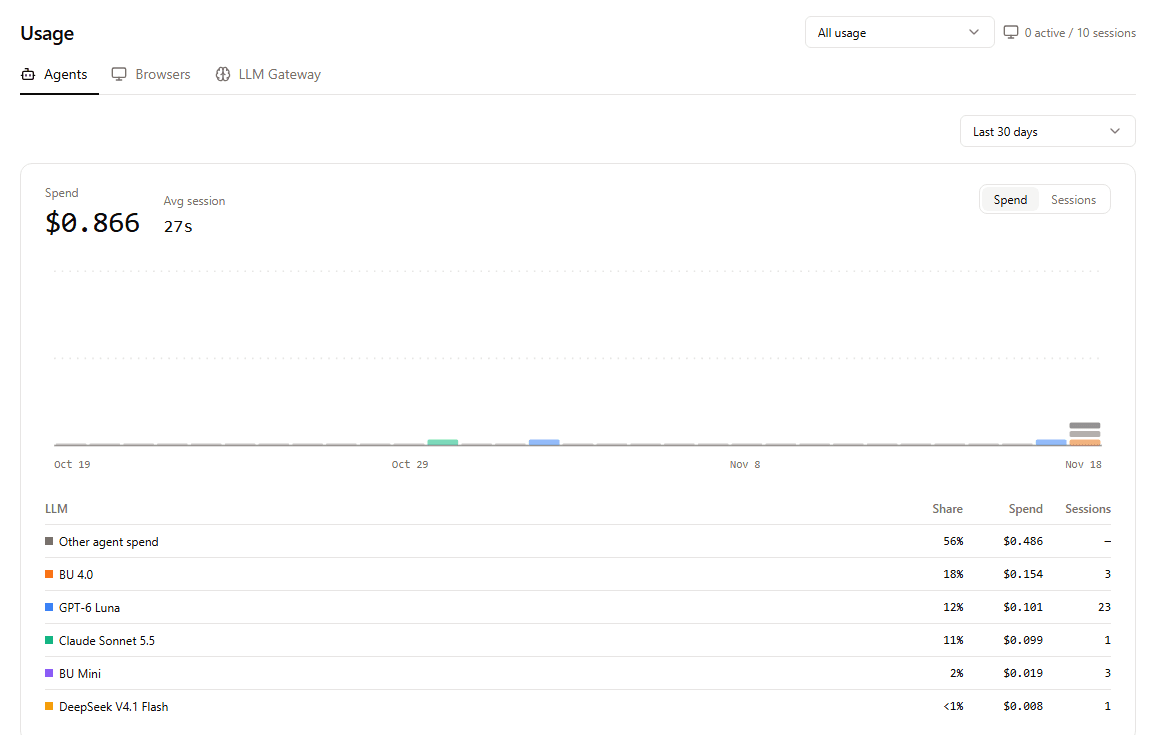
That matters because BU 4.0 is now the default for new projects. If you never set model, you're on the expensive end. Browser Use describes BU 4.0 as its best balance and BU 4.0 Pro as the most capable, but simple extractions like these didn't need either. Pick the model per task, and set it explicitly.
3. The cheapest model isn't always right
bu-ultrafast was the cheapest on all three tasks, at $0.0024, $0.0081 and $0.0071. On Hacker News and GitHub its answers matched the others.
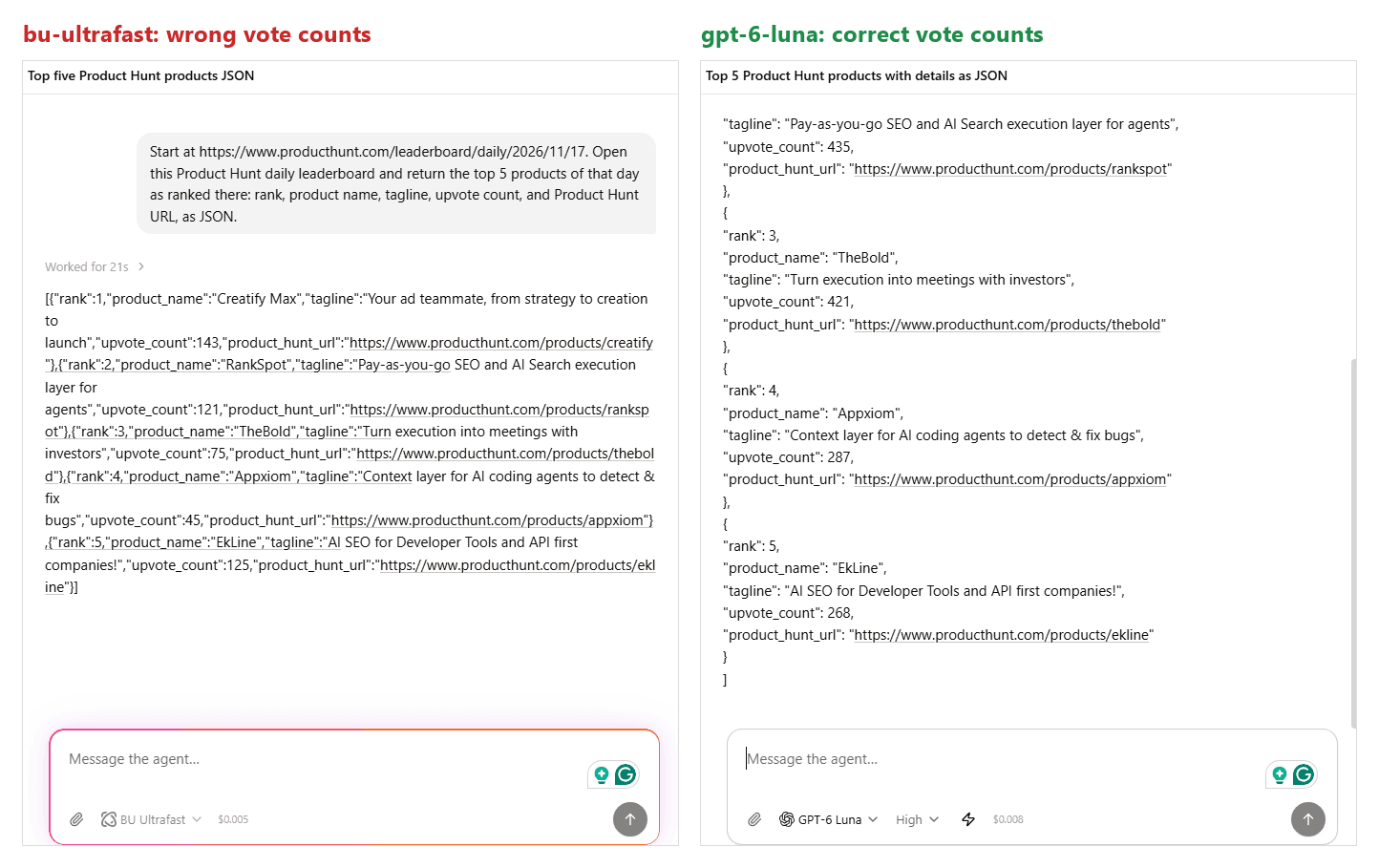
On Product Hunt it got the vote counts wrong: 143, 121, 75, 45 and 125, where every other model read 425, 435, 421, 287 and 268. It also took 13 steps, more than any other model on that page. A cheap run that returns wrong data isn't cheap. Validate the output before you trust a model on a new site.
A detail I can't fully explain: the bu-ultrafast sessions billed their traffic at the direct rate (about $0.20 per GB) even with the default proxy setting. Its GitHub run moved 20.99 MB and paid $0.0041 for it.
4. Browser time barely matters
Every session in this test billed 1 to 1.33 minutes of browser time: $0.0010 to $0.0013. At $0.06 per hour, browser time only shows up on your bill if you keep browsers open for a long time, for example with a long keepAlive waiting for follow-ups.
Read the cost after the browser stops
This one caught me off guard.
Twenty seconds after each run finished, the session cost endpoint showed browserCostUsd: "0.080000" on all 15 sessions. Four minutes later, after the browser had stopped, it had settled to $0.0010 to $0.0013. The proxy line moved too: on the GitHub run with gpt-6-luna it grew from 17.56 MB ($0.0857) to 21.15 MB ($0.1033) between the two reads.
The docs warn that browser and proxy costs keep changing until the browser stops, and that LLM charges can settle up to about 90 seconds after a run. In practice: if you log costs per run, read them a few minutes after the session ends, not in the same step that receives the result.
A simple cost calculator
Per run:
cost ≈ model fees + (proxy MB ÷ 1,024 × proxy rate) + (browser minutes × $0.001)
with a proxy rate of $5 per GB through the residential proxy, or $0.20 per GB with it off.
The same formula in Python, using my measured averages as defaults:
def run_cost(llm_usd, proxy_mb, proxy_on=True, browser_minutes=1.0):
    rate = 5.00 if proxy_on else 0.20          # USD per GB
    return llm_usd + proxy_mb / 1024 * rate + browser_minutes * 0.06 / 60

# GitHub task, gpt-6-luna: measured llm $0.0047, 21.15 MB
print(round(run_cost(0.0047, 21.15, proxy_on=True), 4))   # 0.109
print(round(run_cost(0.0047, 21.15, proxy_on=False), 4))  # 0.0098
Scale it to a month, using the measured totals:
| Workload | Per run | Per month |
|---|---|---|
| Daily Product Hunt digest, gpt-6-luna, proxy on | $0.0181 | $0.54 |
| Same, proxy off | $0.0096 | $0.29 |
| 1,000 GitHub-style checks a day, BU 4.0, proxy on | $0.1643 | about $4,900 |
| Same, gpt-6-luna, proxy off | $0.0098 | about $295 |
Same work, same answers in my tests, about a 17× difference at scale. Two settings decide most of it: the model and the proxy.
How to keep the bill down
- Set
modelexplicitly. Don't inherit the default. Start with a cheaper model and move up only for tasks that need it. - Try the task with the proxy off (
proxyCountryCode: null). If the site loads and the data is right, keep it off for that site. - Set
maxCostUsdon every run. It's a hard cap per run, and a loop that goes wrong stops there. - Validate the output, especially with the cheapest models. A wrong answer costs more than the run.
- Stop browsers you don't need. Closing your CDP connection doesn't stop a cloud browser.
PATCH /api/v4/browsers/{id}with{"action": "stop"}does. - Budget from the session cost, read after the browser stops, not from the run's
totalCostUsd.
FAQ
How much does a browser agent cost per task?
In my tests on Browser Use Cloud, between $0.0024 and $0.164 per run, all-in. Simple pages with a cheap model cost well under a cent. Heavy pages through a residential proxy with the BU 4.0 model cost more than ten cents.
What is the most expensive part of a browser agent?
It depends on the page. On light pages it's the model. On heavy pages it's the residential proxy: on a 21 MB GitHub task the proxy was up to 94% of the bill. Browser time was never more than $0.0013 per session.
How much does Browser Use charge for browsers and proxies?
$0.06 per browser hour, billed by the minute with a 1-minute minimum, plus $5 per GB through the managed residential proxy or $0.20 per GB with the proxy off. Model fees are per million tokens and depend on the model.
Why doesn't the run's totalCostUsd match my bill?
Because a run's totalCostUsd only covers model and search charges. Browser time and proxy traffic are billed to the session. Read GET /api/v4/sessions/{id}/cost for the full amount, after the browser has stopped.
Can I turn off the proxy to save money?
Yes. Set proxyCountryCode to null in the run's browserSettings. Traffic is then billed at $0.20 per GB instead of $5. It worked on all three sites I tested, but some sites block traffic that doesn't come from a residential IP, so test each site.
Is the cheapest model good enough?
Sometimes. bu-ultrafast was the cheapest on every task and right on two of three, but it read the wrong vote counts on Product Hunt. Check a model's answers on your own pages before you switch to it.
Key takeaways
- A browser agent's cost is model + proxy + browser. Most tools only show you the model.
- On heavy pages, the residential proxy is the bill. Turning it off, where the site allows it, cut a run 11×.
- The default model is the expensive one. Choosing the model per task cut model fees 7.5 to 15.5×, with the same answers here.
From here
If you want to build something with these numbers, my n8n browser agent tutorial runs a daily workflow for about two cents a run, and the Browser Use review covers the stealth tests behind the proxy.
A browser agent isn't expensive or cheap.
Two settings decide which one yours is.
Looking for technical content for your company? I can help — LinkedIn · kevinmenesesgonzalez@gmail.com