7 Best AI Search Visibility (GEO) Tools in 2026
Your brand can rank #1 on Google and still not exist inside ChatGPT.
That isn't a hypothetical. When a buyer asks an assistant "what's the best tool for X?", the answer is a short list of three to five names. If you're not on it, you never get the click, the demo or the chance to compete.
If you're:
- running SEO for a SaaS or API company,
- managing content for a brand that lives on comparisons,
- or selling GEO services to clients,
you need to see that list before you can change it.
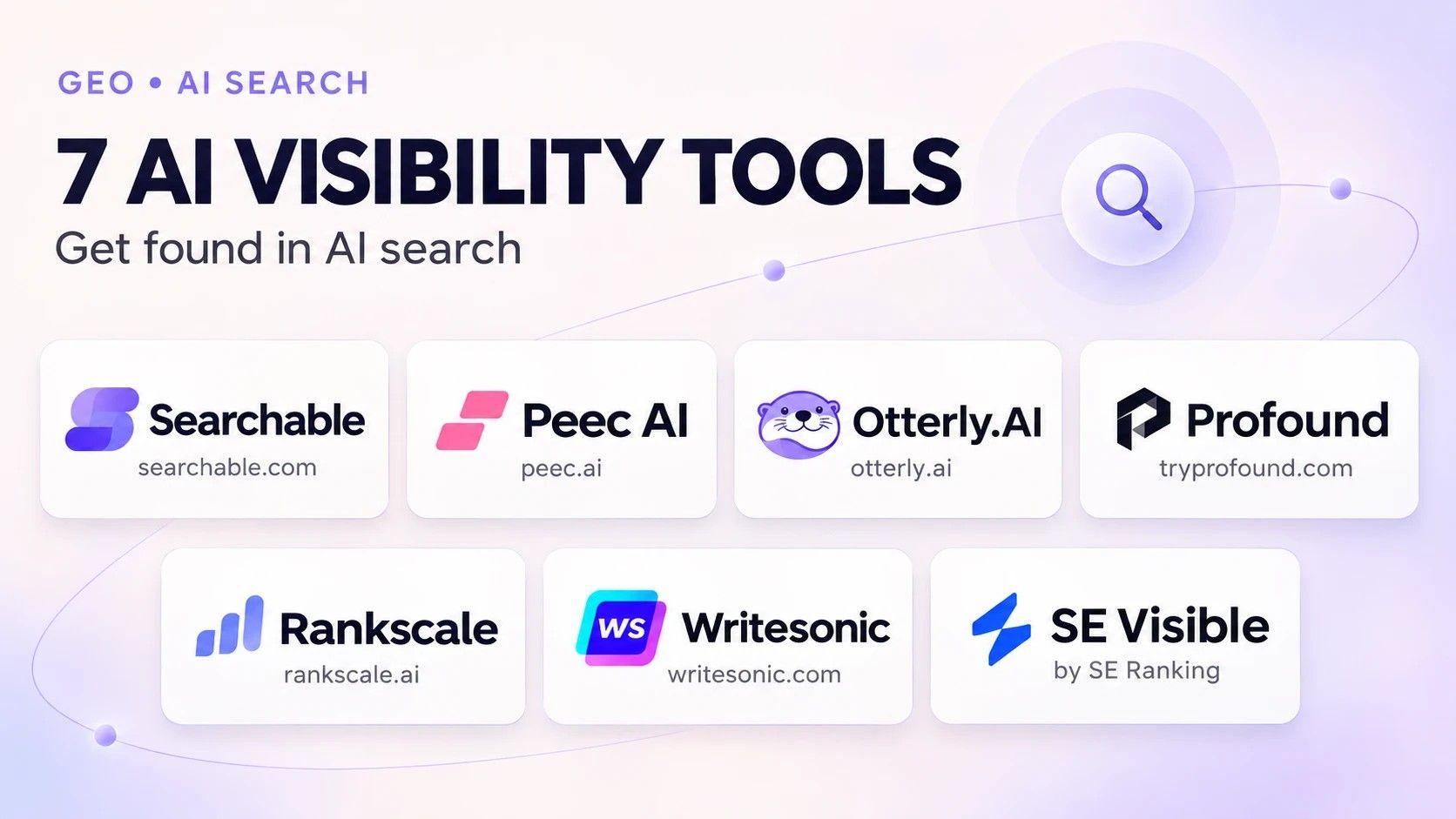
That's the job of AI search visibility tools (also called GEO tools, AI visibility tools or LLM visibility trackers). Below are the 7 I'd shortlist in 2026, including mid-size players that rarely make the big-vendor lists, with prices checked on each official pricing page on November 22, 2026.
TL;DR
- Best overall for brand teams: Searchable, from $125/mo with tracking, audits, content, MCP and API in one plan.
- Best for multi-market teams and agencies: Peec AI, from $95/mo with unlimited users.
- Cheapest serious option: Otterly.AI, from $29/mo for 20 prompts.
- Enterprise: Profound, custom pricing only since September 2026.
- Most engines per euro: Rankscale, 17+ engines on every plan from €99/mo.
- GEO plus content production: Writesonic, from $79/mo.
- Already on SE Ranking: SE Visible, from about $71/mo for 75 prompts.
- Before paying, run 5 prompts yourself with the free Python script below to see whether you have a visibility gap.
What an AI search visibility tool actually does
A classic rank tracker asks one question: where does my URL rank for this keyword?
A GEO tool asks a different one: when someone asks an AI assistant about my category, does my brand show up, and who gets cited instead?
Under the hood, almost every tool does the same four things:
- Runs a fixed set of prompts on a schedule (daily or weekly).
- Sends them to engines like ChatGPT, Perplexity, Gemini, Google AI Overviews and AI Mode, Claude or Copilot.
- Parses each answer for brand mentions, position in the list, sentiment and cited URLs.
- Rolls it up into share of voice against your competitors.
The differences are in the details: how many prompts you get per dollar, which engines are included, whether answers come from the real app or from the API, and what the tool helps you do once you see a gap.
Why your rank tracker can't see this
AI answers are not a stable list of ten blue links.
Ask ChatGPT the same question twice and you can get two different shortlists. Ask it from another country and you get a third. Ask through the API instead of the app and the model may skip web search entirely.
So a single manual check proves nothing.
You need the same prompts, run repeatedly, across several engines, with the citations logged. That's sampling, not ranking, and it's why this tool category exists.
There's a second gap too. Google Search Console tells you about clicks. It doesn't tell you that Perplexity keeps citing a competitor's comparison page when someone asks about your exact use case.
How I compared them: the same 5 prompts
To keep the comparison fair, I used one prompt set as the lens for every tool: the five prompts I'd load first for any B2B SaaS brand.
- Discovery: "What is the best [category] tool for [use case]?"
- Alternatives: "What are the best alternatives to [main competitor]?"
- Head-to-head: "[Your brand] vs [competitor]: which is better?"
- Reputation: "Is [your brand] worth it?"
- Job to be done: "How do I [task your product solves]?"
For each tool I looked at what it would cost to track those 5 prompts (and then 100) across the engines that matter, plus:
- engines included vs. paid add-ons,
- what happens after tracking (content, audits, recommendations),
- API or MCP access for teams that want the data elsewhere.
One honest note: I didn't run paid trials for this piece. Prices and features come from each vendor's own pricing page, checked on the date above. Pricing in this category changes fast (Profound retired its self-serve plans in September 2026), so re-check before you buy.
AI visibility tools compared
| Tool | Entry price | Prompts at entry | Engines at entry | Best for |
|---|---|---|---|---|
| Searchable | $125/mo (annual) | 100 per model | ChatGPT, AI Overviews, Perplexity (+ add-ons) | In-house brand teams that want tracking and fixes in one place |
| Peec AI | $95/mo | 50 | Pick 3 of 8 | Marketing teams and agencies, multi-market brands |
| Otterly.AI | $29/mo (annual) | 20 | Pick 3 of 7 | Solo marketers and small budgets |
| Profound | Custom | Custom | Up to 10 | Enterprise brands |
| Rankscale | €99/mo (€84 yearly) | Unlimited (4,800 answers/mo) | 17+ engines | Agencies and data-heavy teams |
| Writesonic | $79/mo (annual) | 50 | ChatGPT, Gemini, AI Overviews | Teams that want GEO plus content production |
| SE Visible by SE Ranking | ~$71/mo (annual) | 75 | ChatGPT, Gemini, Copilot | SEO teams already on SE Ranking |
The 7 best AI search visibility tools in 2026
1. Searchable: best all-in-one GEO platform for brand teams
Searchable combines AI visibility tracking with the work that comes after it: site audits, content creation and technical fixes. The Pro plan tracks 100 prompts per model daily across ChatGPT, Google AI Overviews and Perplexity, and you can add Claude, Gemini, AI Mode, Copilot, DeepSeek, Grok and Meta as paid models.
What stands out is how much ships in the entry plan: 20 articles and 200 audits a month, citation tracking, agent analytics (AI crawler and AI-referred traffic), AI shopping data, an MCP server and API access, with unlimited seats.
Pros
- Tracking, audits and content in one tool, so a visibility gap turns into a task, not a spreadsheet row
- MCP and API on every plan, so you can query visibility data from Claude or your own dashboards
- Unlimited seats and unlimited countries from the first plan
- 14-day free trial
Cons
- Only 3 engines included; Gemini, Claude and AI Mode cost extra
- Annual billing on the listed prices
- Looker Studio and white-label reports start at Scale ($400/mo)
Best for: in-house SEO and content teams at SaaS brands that want one tool to find gaps and close them.
Pricing: Pro $125/mo, Scale $400/mo, Enterprise from $999/mo (billed annually).
2. Peec AI: best for marketing teams tracking several markets
Peec AI is one of the most-searched names in the category (around 2,900 US searches a month), and it's built around clean competitive benchmarking: visibility, position and sentiment for your brand against the competitors you choose, with source analysis for every answer.
Its engine list is unusually global. Beyond ChatGPT, Perplexity, Gemini, AI Overviews and AI Mode, it covers Bing AI Mode, Naver AI Briefing (Korea) and Baidu's ERNIE. On paid plans you choose 3 active models; Enterprise opens up to 26.
Pros
- Unlimited users on every plan
- Rare coverage of Naver and ERNIE for brands selling in Asia
- Daily tracking from the Starter plan
- Dedicated agency pricing for multi-brand setups
Cons
- Only 3 active models on Starter, Pro and Advanced
- No API until Enterprise
- 50 prompts on Starter goes fast once you add competitors and markets
Best for: marketing teams and agencies benchmarking several brands or regions.
Pricing: Starter $95/mo (50 prompts), Pro $245/mo (150), Advanced $495/mo (350), Enterprise custom.
3. Otterly.AI: best budget entry point
Otterly.AI is the cheapest serious way into GEO. The Lite plan tracks 20 prompts daily across 3 engines of your choice from a list of 7 (ChatGPT, Google AI Overviews, Perplexity, Copilot, AI Mode, Gemini, Claude), with sentiment, citation sources and brand profiling included.
It also tracks ChatGPT Ads, which matters now that sponsored placements are showing up inside answers.
Pros
- $29/mo entry with a free trial
- Unlimited brands, competitors, team members, countries and languages on every plan
- ChatGPT Ads tracking included
- API, MCP and agent analytics from the Standard plan
Cons
- 20 prompts is enough for the 5-prompt test, not for a real program
- Big jump from Lite ($29) to Standard ($189)
- 3 engines per plan unless you go Enterprise
Best for: solo marketers, freelancers and small teams validating whether AI visibility is worth a bigger budget.
Pricing: Lite $29/mo, Standard $189/mo, Premium $489/mo (annual pricing shown; monthly is about 15% higher), Enterprise custom.
4. Profound: best for enterprise brands
Profound is the enterprise heavyweight and the most-searched brand here ("profound ai" gets about 6,600 US searches a month). It tracks up to 10 answer engines (ChatGPT, Perplexity, Gemini, Google AI Overviews and AI Mode, Claude, DeepSeek, Exa, Muse Spark and Qwen) with daily frequency, custom languages and regions.
Its edge is everything around the tracking. Agent analytics connects to Cloudflare, Vercel, Akamai, Fastly, AWS and others to show which AI bots hit your site and what traffic they send back. Prompt Volumes estimates what people actually ask AI engines. And its "AI Marketer" agents turn insights into briefs and content.
Pros
- Widest engine coverage of the list, including Exa and Qwen
- Server-level agent analytics with CDN integrations
- Prompt volume data, not just tracking
- SOC 2, SSO, unlimited seats and an API
Cons
- Enterprise only: the $399 and $499 self-serve plans were retired in September 2026
- No public price; you need a sales demo
- Overkill if you only need to track a few dozen prompts
Best for: large brands and enterprise marketing teams with budget and compliance requirements.
Pricing: custom.
5. Rankscale: best value per engine
Rankscale takes a different pricing model. Instead of capping prompts, it gives you unlimited prompts and a monthly budget of AI answers: 4,800 answers on the Pro plan, spread across 17+ engines and model variants.
That detail matters. Rankscale lets you choose between the real app interface (ChatGPT app, Google AI Mode, AI Overviews) and API models with or without web search. App answers are what users actually see; API answers are cheaper but can differ. Few tools make that distinction this explicit.
Pros
- Every engine on every plan, including Claude, DeepSeek and Mistral
- App vs. API choice per engine, priced in credits
- MCP and a sentiment radar from the first plan
- Up to 10 brand dashboards on Pro
Cons
- Credit math takes a minute to understand
- REST API starts at Pro+ (€229/mo)
- White-label needs the Growth plan (€385/mo)
Best for: agencies and analysts who want broad engine coverage without paying per model.
Pricing: Pro €99/mo (€84.15/mo billed yearly), Pro+ €229/mo, Growth €385/mo. 7-day trial.
6. Writesonic: best if you also need content at scale
Writesonic started as an AI writer and has repositioned as an AI search visibility platform. The pitch is the loop: track where you're missing in ChatGPT, Gemini and Google AI Overviews, then use its content and SEO tools and agentic workflows to publish the pages that fill the gap.
Pros
- Tracking and content production under one subscription
- Agentic workflows for recurring SEO and content tasks
- Low entry price for a combined tool
- Free trial
Cons
- Only 3 engines below Enterprise (no Perplexity or Claude on self-serve plans)
- 50 prompts at entry
- Less depth on citations and sources than tracking-first tools
Best for: content teams that want one subscription for both visibility and production.
Pricing: Starter $79/mo (50 prompts), Basic $199/mo (100), Growth $399/mo (200), billed annually. Enterprise custom.
7. SE Visible by SE Ranking: best for teams already doing SEO in SE Ranking
SE Ranking is a mid-size SEO suite that a lot of agencies already pay for, and SE Visible is its standalone AI visibility product. It tracks brand mentions, positions and sources across AI engines, and connects naturally to the keyword and backlink data you already have in SE Ranking.
It shows up in almost every competing "best GEO tools" list, and for good reason: it's affordable and familiar to SEO teams.
Pros
- 75 prompts at entry, more than most tools at the same price
- Agency plan with 1,000 prompts
- Fits into an existing SE Ranking workflow
- Free trial
Cons
- Smaller engine list on lower plans (ChatGPT, Gemini and Copilot; Claude on Agency)
- AI visibility is split between SE Visible and an add-on inside the SEO suite, which can confuse buyers
- Fewer content or action features than Searchable or Writesonic
Best for: SEO teams and agencies already using SE Ranking that want AI visibility without learning a new platform.
Pricing: Basic about $71/mo billed annually ($89 monthly), Core $189/mo, Agency $399/mo, Enterprise custom.
Honorable mentions
These didn't make the 7, but they're worth a look depending on your stack:
- Semrush AI Visibility Toolkit: $99/mo for 25 prompts on ChatGPT and AI Mode. Easiest if you already live in Semrush; thin on prompts for the price.
- Ahrefs Brand Radar: strong for brand mention research inside Ahrefs.
- AthenaHQ: credit-based, 11 engines on the $295/mo Starter, with a free Essential tier that includes $25 of credit.
- Search Atlas: AI visibility credits bundled into an SEO and content automation suite from $99/mo.
Build a free baseline in Python before you pay
Before you buy any of these, run the 5 prompts yourself. It takes ten minutes and tells you whether you have a problem worth paying to track.
# pip install openai
from openai import OpenAI

client = OpenAI()  # reads OPENAI_API_KEY
MODEL = "gpt-5-mini"  # any current chat model

BRAND = "YourBrand"
COMPETITORS = ["CompetitorA", "CompetitorB"]
PROMPTS = [
    "What is the best email API for developers?",
    "What are the best alternatives to CompetitorA?",
    "YourBrand vs CompetitorA: which is better?",
    "Is YourBrand worth it?",
    "How do I send transactional emails from a Node.js app?",
]
RUNS = 3  # answers vary, so sample each prompt more than once

for prompt in PROMPTS:
    hits = {name: 0 for name in [BRAND] + COMPETITORS}
    for _ in range(RUNS):
        answer = client.chat.completions.create(
            model=MODEL,
            messages=[{"role": "user", "content": prompt}],
        ).choices[0].message.content.lower()
        for name in hits:
            hits[name] += name.lower() in answer
    print(f"{prompt[:50]:<50} " + "  ".join(f"{k}: {v}/{RUNS}" for k, v in hits.items()))
Output looks like this:
What is the best email API for developers?         YourBrand: 0/3  CompetitorA: 3/3  CompetitorB: 2/3
What are the best alternatives to CompetitorA?     YourBrand: 1/3  CompetitorA: 0/3  CompetitorB: 3/3
Two caveats, and they're exactly why the paid tools exist:
- API answers are not app answers. The ChatGPT app uses web search, memory and its own system prompt. Your script sees the raw model.
- One engine, one day, three runs is a snapshot. Tools run hundreds of prompts daily across many engines and keep the history.
If your brand shows up 0 out of 3 times on the discovery prompt while two competitors show up every time, you have your business case.
Need this kind of research turned into content your buyers actually read? I write technical comparisons and tutorials for SaaS and API companies. Let's talk on LinkedIn.
How to choose the right GEO tool
Match the tool to where you are, not to the longest feature list:
- Testing the waters on a small budget: Otterly.AI Lite, or SE Visible if you're already on SE Ranking.
- In-house SaaS team that needs to fix gaps, not just see them: Searchable.
- Several markets, unlimited teammates, agency work: Peec AI.
- Broad engine coverage for analysis or client reporting: Rankscale.
- Content production is the bottleneck: Writesonic.
- Enterprise budget, compliance and server-level analytics: Profound.
Whatever you pick, start with the same 5 prompts. If the tool can't show you clearly who wins the discovery and alternatives prompts in your category, it won't help you change that.
Key takeaways
- AI search visibility is sampling, not ranking: you need the same prompts, run often, on several engines.
- Entry prices range from $29 to custom, but prompts per dollar and included engines vary more than the headline price.
- Tracking alone doesn't move the needle; pick a tool that also tells you which pages and sources to fix.
FAQs
What is a GEO tool?
A generative engine optimization (GEO) tool tracks how often and how favorably AI assistants like ChatGPT, Perplexity, Gemini and Google AI Overviews mention your brand. It runs a set of prompts on a schedule, logs mentions, positions, sentiment and cited sources, and compares you with competitors.
What is the best AI visibility tool for small businesses?
Otterly.AI is the cheapest serious option at $29/mo for 20 prompts. If you need more prompts for a similar budget, SE Visible starts at about $71/mo for 75 prompts.
Are there free AI search visibility tools?
Most tools offer free trials rather than free plans. AthenaHQ has a free tier with $25 of credit. You can also build a basic baseline yourself with a short Python script against the OpenAI API, as shown above.
What are the best Profound alternatives?
Since Profound moved to enterprise-only pricing, the most common alternatives are Peec AI, Searchable, Otterly.AI and Rankscale, all with public, self-serve plans under $130/mo to start.
How many prompts should I track?
Start with 5 to validate the problem, then scale to 50 to 100 prompts that cover discovery, alternatives, comparisons, reputation and jobs to be done for each product line.
Final thoughts
Google rankings told you where you stood. AI answers decide whether you're in the conversation at all.
The tools above make that visible. What you do with it (better comparison pages, more citations, clearer positioning) is what actually gets your name into the next answer.