StocksStock Market TipsStock Market InvestingStocks To WatchBest Stocks
From Apple to Palantir — these are the 10 stocks retail investors keep adding to their portfolios, and why each one earns a recurring spot.
Markets go up. Markets go down. Sectors rotate in and out of favor.
And yet, certain tickers keep appearing in the same portfolios, year after year.
Not because they’re guaranteed winners. Not because some algorithm selected them. But because long-term investors have decided, repeatedly and deliberately, that these names deserve a permanent spot in their strategy.
If you’re:
building a portfolio designed to hold for 5, 10, or 20 years,
looking for stocks with a clear long-term narrative,
or trying to understand what the broader retail investing community keeps coming back to,
These 10 names are worth knowing.
Why These Stocks Keep Showing Up
The tickers on this list don’t share a sector or a valuation style. Some are mature blue chips. Others are high-growth bets. A few are deeply controversial.
What they share is different:
A long-term narrative investors can hold onto through volatility
High liquidity and name recognition that reduces friction to buy
Strong presence in retail investing communities and portfolio trackers
A track record — positive or turbulent — that makes them impossible to ignore
This isn’t a buy list. It’s a map of where long-term investor conviction keeps pointing.
The most widely held stock among retail investors globally. Apple sits at the intersection of consumer loyalty, services growth, and ecosystem lock-in.
Why investors keep buying it:
Services revenue (App Store, iCloud, Apple Pay) now drives margins higher than hardware
One of the most consistent buyback programs in the market, returning capital to shareholders every year
Anchor position in virtually every major index and ETF — owning the market means owning Apple
The risk to keep in mind:
Valuation is rarely cheap. Apple trades at a premium that assumes continued execution, leaving little room for disappointment.
Microsoft transformed itself from a legacy software company into a cloud and AI powerhouse. Azure and its deep integration with OpenAI’s technology have repositioned it as one of the central bets on enterprise AI adoption.
Why investors keep buying it:
Azure is the second-largest cloud platform globally, growing double digits year over year
Its partnership with OpenAI gives it direct exposure to AI adoption across enterprise customers
Consistent dividend growth — Microsoft has increased its dividend every year for over a decade
The risk to keep in mind:
At its scale, growth requires increasingly large markets. Competition from AWS and Google Cloud is intensifying.
Amazon is rarely cheap, rarely simple, and almost never boring. Long-term investors return to it because no other company operates at its combination of scale, infrastructure, and market reach.
Why investors keep buying it:
AWS remains the dominant cloud platform globally, generating the bulk of Amazon’s operating profit
Advertising is now a multi-billion-dollar business growing faster than the core retail segment
Every market Amazon enters — logistics, healthcare, streaming, AI infrastructure — becomes a long-term story of its own
The risk to keep in mind:
Regulatory pressure across multiple jurisdictions is a persistent overhang on the stock.
Alphabet is, at its core, a search monopoly that has spent two decades diversifying. Long-term investors hold it as a combination of a cash-generating core business and a portfolio of long-term bets on AI, autonomous vehicles, and cloud.
Why investors keep buying it:
Google Search and YouTube together represent one of the most durable advertising duopolies ever built
Google Cloud is growing fast and approaching profitability, adding a second growth engine
Trading at a significant discount to peers on a price-to-earnings basis, which makes it one of the most debated “value” plays in big tech
The risk to keep in mind:
AI-powered search is the first real structural threat to the Google Search business model in 20 years. The transition carries genuine uncertainty.
No stock in recent memory has captured long-term investor attention more completely than NVIDIA. The AI infrastructure buildout turned its GPU business from a gaming niche into the backbone of modern AI training.
Why investors keep buying it:
Data center revenue has grown from a secondary segment to the dominant driver of the business
CUDA — NVIDIA’s software ecosystem — creates deep switching costs that go beyond the hardware itself
Demand for AI compute infrastructure shows no signs of slowing across hyperscalers and enterprise
The risk to keep in mind:
Valuation expanded dramatically with the AI narrative. Any slowdown in data center spending would hit the stock hard and fast.
6. AMD — Advanced Micro Devices
AMD is NVIDIA’s most credible competitor in the AI chip space — and the stock that benefits when investors want AI infrastructure exposure without paying NVIDIA’s premium.
Why investors keep buying it:
MI300X GPUs are gaining traction with hyperscalers looking to diversify away from NVIDIA dependency
Data center revenue growing rapidly from a smaller base, creating more upside potential per dollar invested
CPU market share against Intel has been growing consistently for several years
The risk to keep in mind:
AMD is competing against NVIDIA on NVIDIA’s home turf. Closing the software ecosystem gap is a multi-year challenge, not a given.
7. TSLA — Tesla
Tesla is the most polarizing stock on this list — and one of the most consistently bought. Long-term holders tend to own a thesis about energy transition, autonomy, and manufacturing scale rather than a view on next quarter’s deliveries.
Why investors keep buying it:
The Supercharger network and energy storage business (Powerwall, Megapack) are assets no competitor has replicated
Full Self-Driving and the robotaxi vision represent optionality that makes the stock difficult to value — and impossible to ignore
Tesla’s manufacturing cost per vehicle continues to decline as gigafactories reach scale
The risk to keep in mind:
Brand perception has shifted in key markets. Competition from Chinese EV manufacturers is intensifying rapidly, particularly in Europe and Asia.
Palantir is the AI software company that retail investors have turned into a conviction bet on the intersection of government data intelligence and enterprise AI adoption. Volatile, expensive, and relentlessly debated.
Why investors keep buying it:
AIP (Artificial Intelligence Platform) is accelerating commercial adoption at a pace that surprised even the bulls
U.S. government contracts provide a durable revenue base that most software companies can’t replicate
Revenue grew 56% year-over-year in 2025 — the kind of growth rate that keeps growth investors coming back regardless of valuation
The risk to keep in mind:
Palantir trades at one of the highest price-to-sales ratios of any profitable software company. The multiple leaves almost no margin for error.
SPY isn’t a stock — it’s the market. And it keeps appearing in long-term portfolios because for most investors, owning the index is the most rational core position they can hold.
Why investors keep buying it:
Instant diversification across 500 of the largest US companies with a single purchase
One of the most liquid instruments in the world, with decades of performance history tracking the S&P 500
Used by both passive investors as a core holding and active investors as a benchmark anchor or hedge
The risk to keep in mind:
SPY is market-cap weighted, which means it’s more concentrated in the top 10 holdings than many investors realize. Owning SPY means being heavily exposed to big tech whether you intend to or not.
10. HOOD — Robinhood
Robinhood is the fintech story that keeps evolving. Started as a commission-free trading app, it has transformed into a diversified financial platform with crypto, retirement accounts, credit cards, and a fast-growing Gold subscription service.
Why investors keep buying it:
Robinhood Gold reached over 4.2 million subscribers, creating a recurring revenue stream that reduces dependence on trading volume
Revenue more than doubled in Q4 2025, with crypto up 300% and equity trades up 132% year-over-year
The company is actively expanding into wealth management and prediction markets, widening its long-term addressable market
The risk to keep in mind:
Regulatory exposure is real and recurring. The business model intersects with nearly every financial regulator, and surprises in this area move the stock significantly.
What These Stocks Have in Common
Across sectors, valuations, and business models, these 10 names share a few structural traits that keep them in long-term portfolios:
A narrative that survives market cycles. Whether it’s AI infrastructure, cloud dominance, or fintech disruption, each of these companies has a story investors can hold through volatility without losing conviction.
Brand recognition that reduces friction. Retail investors return to companies they understand and interact with. Apple, Amazon, Google, and Tesla are part of daily life — that familiarity matters.
Presence in major indices and ETFs. Most of these names appear in SPY, QQQ, and other broad market funds. Owning the index means owning them — which reinforces their position in active portfolios too.
Active investor communities. Reddit threads, YouTube channels, financial newsletters, and portfolio trackers all amplify attention around these names, creating a feedback loop of visibility and conviction.
How to Track All of Them in One Place
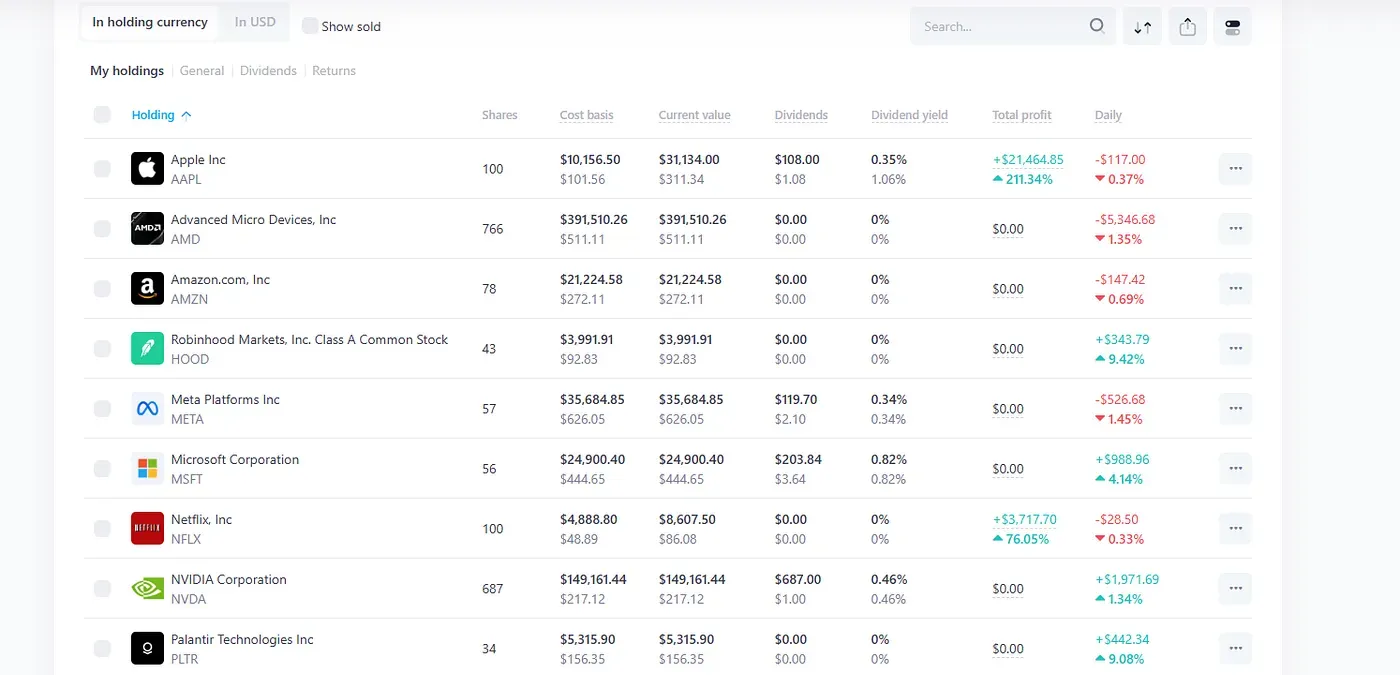
If several of these stocks are already in your portfolio — or you’re considering adding them — the challenge quickly becomes visibility.
How much of your total capital is actually in AI infrastructure stocks? If you hold NVDA individually, AMD, and an SPY position that includes both, your real tech exposure might be higher than you think.
This is exactly what Snowball Analytics surfaces automatically. Connect your broker accounts and the platform breaks down your real allocation across sectors, shows you performance against benchmark indices, and tracks upcoming dividend payments — all in one dashboard.
For a portfolio built around long-term conviction positions like the ones on this list, that kind of clarity isn’t optional. It’s how you stay intentional about what you own and why.
❓ What stocks do long-term investors buy most?
✅ The most consistently held stocks among retail long-term investors include Apple (AAPL), Microsoft (MSFT), Amazon (AMZN), Alphabet (GOOGL), and NVIDIA (NVDA) — alongside growth bets like Palantir (PLTR) and Robinhood (HOOD). These names appear repeatedly because they combine strong long-term narratives with high liquidity and broad market presence.
❓ Is SPY a good long-term investment?
✅ SPY tracks the S&P 500 index and has historically delivered around 10% average annual returns over long periods. For most retail investors, it serves as a core holding that provides instant diversification across 500 large US companies. The main caveat is that it’s heavily weighted toward the top holdings — primarily large-cap tech — so it’s less diversified than the 500-company count suggests.
❓ Is PLTR stock good for long-term investors?
✅ Palantir’s long-term thesis rests on AI software adoption across government and enterprise clients. Revenue growth has been exceptional, but the stock trades at a very high valuation multiple. Long-term investors who hold PLTR typically do so with a high-conviction view on AI software adoption rather than near-term value. The risk-reward is asymmetric in both directions.
❓ How do I track multiple stocks across different brokers?
✅ Portfolio tracking tools like Snowball Analytics let you connect multiple broker accounts and consolidate your holdings into a single dashboard. You can see your real sector allocation, benchmark performance against the S&P 500, and track upcoming dividend payments — all updated automatically without manual data entry.