Most developers assume that using a broker’s API gives you a direct advantage when building financial tools.
The assumption: if your broker has an API, you might as well use it for data.
The reality: trading APIs and data APIs solve fundamentally different problems — and confusing the two will cost you weeks of unnecessary setup, a running desktop app, and a live brokerage account before you write a single line of analysis code.
If you’re:
building a stock screener or portfolio analyzer,
automating financial research with Python,
or integrating market data into an AI agent,
This comparison matters.
What Interactive Brokers API Actually Is (And What It Isn’t)
Interactive Brokers is a serious brokerage. Their API — built around TWS (Trader Workstation) and the ib_insync Python library — is designed for one primary use case: executing trades programmatically from a live account.
It also exposes market data. Historical prices, fundamentals, options chains. The data is there.
But the access model is the problem.
To pull a single historical price series using the IBKR API, you need:
An active Interactive Brokers brokerage account (funded or paper)
TWS or IB Gateway running locally on your machine
A socket connection open on port 7497 or 4002
Pacing limits: IBKR throttles historical data requests to ~60 per 10 minutes
That’s the setup before you write any analysis logic.
Here’s the simplest working example using ib_insync:
date   close
20  2026-04-28  211.23
21  2026-04-29  213.45
...
This works. But notice what it requires: a running desktop application, an authenticated session, and a live connection. If TWS isn’t open, your script fails silently. If you’re running this on a server, you need IB Gateway configured and maintained.
Pros
Deep integration if you’re already trading with IBKR
Access to live quotes, options data, and order execution in one place
Related articles
Well-maintained Python library (ib_insync)
Cons
Requires a funded or paper brokerage account
TWS or IB Gateway must be running — not suitable for lightweight server deployments
Historical data pacing restrictions limit bulk research workloads
Not designed for broad market screening across thousands of symbols
Best for: algo traders who are already IBKR clients and need to combine execution with data in a single workflow.
What EODHD Is (And Why the Model Is Different)
EODHD — End of Day Historical Data — is a pure financial data API. No brokerage account. No desktop software. No socket connections.
One API key. REST calls. JSON responses. That’s it.
The architecture is what makes it developer-friendly by design: you send an HTTP request to an endpoint, you get structured data back. The same way you’d call any modern API — from a Jupyter notebook, a FastAPI backend, a cron job on a cloud server, or an AI agent.
Here’s the equivalent historical price request in EODHD:
date    close
20  2026-04-28   211.23
21  2026-04-29   213.45
...
Same data. No running application. No account requirement. Deployable anywhere.
Pros
REST API — no local dependencies, works on any server or cloud environment
70+ exchanges covered globally, 30+ years of historical data
Fundamentals, macroeconomic indicators, options chains, news sentiment — all under one API key
No pacing restrictions for most endpoints (rate limits are generous on paid plans)
Free tier available for evaluation
Cons
No trade execution — data only (by design)
Real-time quotes have a 15–20 min delay on lower-tier plans
Best for: developers building research tools, AI agents, portfolio analytics, or any financial application where data access needs to be clean, fast, and deployment-independent.
The Most Useful EODHD Endpoints for Developers
EODHD’s value isn’t just in historical prices. The breadth of the API is what differentiates it.
End-of-Day Prices (/api/eod/)
Daily OHLCV for 70+ global exchanges. Adjusted for splits and dividends. 30+ years of history for major symbols.
Fundamentals (/api/fundamentals/)
Full company financials: income statements, balance sheets, cash flow, earnings history, analyst estimates. Structured JSON you can feed directly into a model or dashboard.
Real-Time / Live Data (/api/real-time/)
Delayed quotes (~15–20 min) or real-time on higher plans. Bulk requests supported — fetch up to 50 tickers in one call.
Macroeconomic Indicators (/api/macro-indicator/)
GDP, CPI, unemployment, interest rates per country. Useful for macro-driven models and risk analysis.
News & Sentiment (/api/news/)
Financial news filtered by ticker. Useful for NLP pipelines and sentiment-aware trading signals.
Options Data (/api/options/)
Full options chain per symbol, including Greeks, open interest, and volume.
Each endpoint follows the same REST pattern. You learn one, you know all.
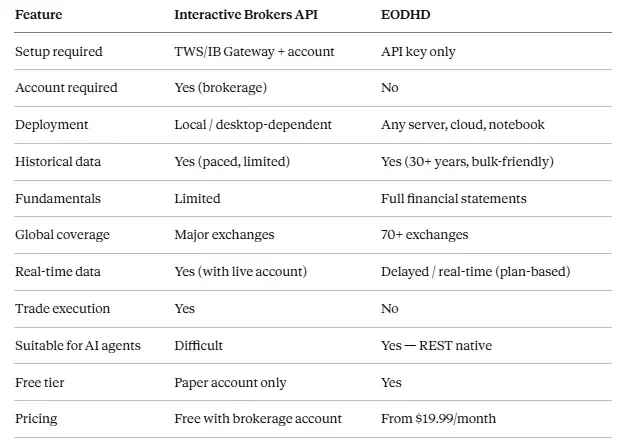
Side-by-Side Comparison
The MCP Advantage: EODHD as an AI-Native Data Layer
This is where EODHD’s architecture creates a significant gap that didn’t exist two years ago.
With the rise of AI agents — tools built on Claude, GPT-4, LangChain, or custom LLM pipelines — financial data access needs to be agent-callable. That means structured, predictable, HTTP-based endpoints that an AI model can invoke without managing state, connections, or authentication flows mid-conversation.
EODHD has an official MCP (Model Context Protocol) server.
This means you can give Claude, Cursor, or any MCP-compatible agent direct access to EODHD endpoints — without writing a single line of integration code.
A practical example: instead of building an API wrapper, a prompt chain, and an output parser, you connect the EODHD MCP server and ask your agent:
“Fetch the last 6 months of Apple’s revenue growth and compare it to its 5-year average.”
The agent calls the fundamentals endpoint, receives structured JSON, and performs the analysis — all within a single reasoning loop.
Here’s what that integration looks like in a Python agent setup using the EODHD MCP:
# Example: Claude SDK + EODHD MCP integration
import anthropic
client = anthropic.Anthropic()
response = client.beta.messages.create(
    model="claude-opus-4-5",
    max_tokens=1024,
    mcp_servers=[
        {
            "type": "url",
            "url": "https://mcpv2.eodhd.dev/v2/mcp",
            "name": "eodhd-mcp"
        }
    ],
    messages=[{
        "role": "user",
        "content": (
            "Using EODHD data, get Apple's (AAPL.US) end-of-day prices "
            "for the last 30 days and calculate the 10-day moving average."
        )
    }]
)
print(response.content[0].text)
Interactive Brokers has no equivalent. The IBKR API requires an open socket, a running GUI application, and explicit connection management — none of which fits the stateless, HTTP-native model that AI agents operate on.
If you’re building anything AI-powered on top of financial data in 2026, the integration model matters as much as the data itself.
You’re already an IBKR client and need to combine order execution with data in a single script
You’re building an algo trading system that needs to execute, not just analyze
You’re running a live trading strategy that requires real-time bid/ask data tied to your positions
Use EODHD when:
You’re building a research tool, screener, or portfolio analyzer with no execution component
You want to deploy a financial data pipeline on a cloud server without managing desktop software
You’re integrating market data into an AI agent, LLM pipeline, or MCP-based workflow
You need global coverage across 70+ exchanges with consistent data structure
You’re prototyping — EODHD’s free tier lets you validate the idea before committing to a plan
The choice isn’t really about which API is “better.” It’s about what your project actually needs.
If your project needs to place orders: use IBKR.
If your project needs clean, accessible, scalable financial data: EODHD is the obvious answer.
FAQs
❓ Can I use the Interactive Brokers API without a funded account?
✅ Yes, IBKR offers a paper trading account that gives you access to their API without real capital. However, you still need to register, get approved, and run TWS or IB Gateway locally. It’s functional for testing but not suited for lightweight or server-based deployments.
❓ Is EODHD free to use?
✅ EODHD has a free tier that includes end-of-day data for US exchanges with limited API calls. It’s enough to prototype and evaluate the API structure. Paid plans start at $19.99/month and unlock fundamentals, global exchanges, bulk endpoints, and real-time data.
❓ Does EODHD provide real-time stock data?
✅ EODHD provides delayed quotes (~15–20 minutes) on standard plans. Real-time data is available on higher-tier plans. For most research, backtesting, and AI agent use cases, delayed data is sufficient and significantly cheaper.
❓ Can I use EODHD with an AI agent or LLM pipeline?
✅ Yes — this is one of EODHD’s strongest advantages in 2026. EODHD has an official MCP server that makes it directly callable from Claude, Cursor, and any MCP-compatible agent. You don’t need to build an API wrapper; you connect the server and your agent can query financial data natively within its reasoning loop.
❓ What’s the best financial data API for Python developers in 2026?
✅ It depends on your use case. If you need trade execution, IBKR is the standard. If you need broad, clean, accessible financial data for analysis, AI, or research — EODHD covers more exchanges, requires less setup, and integrates natively with modern AI tooling via its MCP server.
Final Thoughts
The Interactive Brokers API is a serious tool. Well-maintained, deep, powerful.
But it’s built for traders, not data engineers.
EODHD is built for the other use case: developers who need financial data as a clean input — in a notebook, on a server, inside an agent — without managing a brokerage session in the background.
The gap widens further when you introduce AI agents into the equation. REST-native APIs with MCP support fit how modern LLM pipelines are built. Socket-based desktop APIs don’t.
Choose the tool that matches your architecture, not just your data needs.