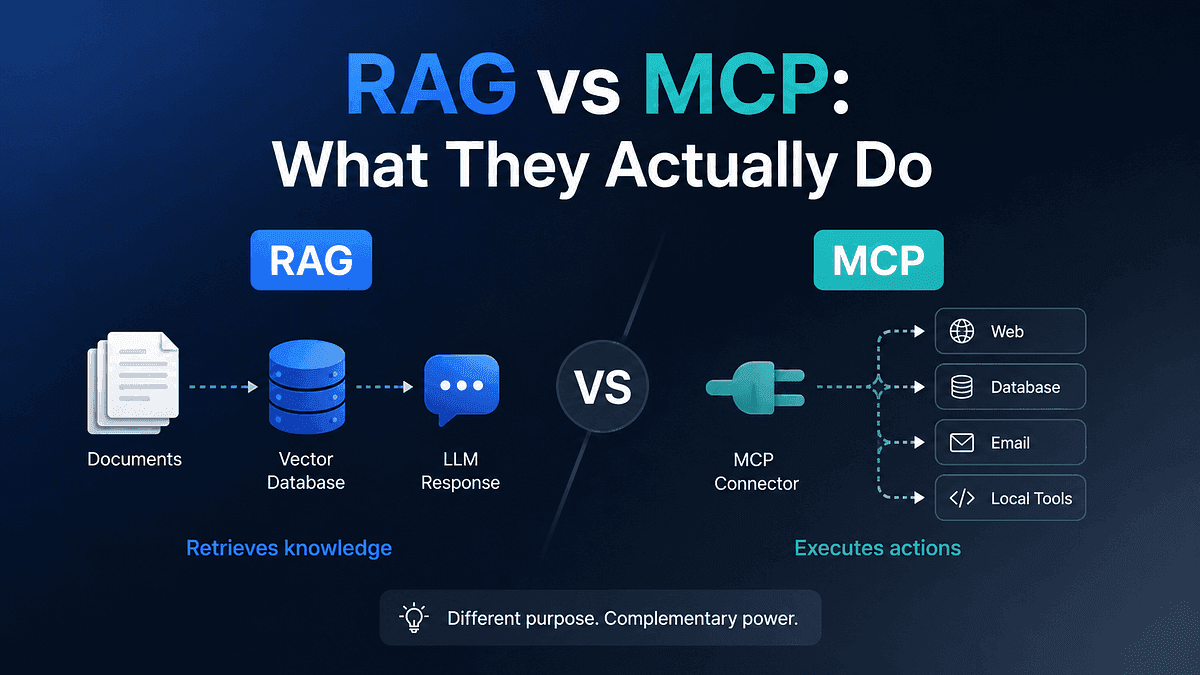
RAG gives a model knowledge it didn’t have at training time by retrieving relevant text and pasting it into the prompt. It reads.
MCP gives a model the ability to call tools and take actions through a standard protocol. It does.
The clean mental split: RAG is for what your documents say. MCP is for what your systems can do.
They are not competitors. RAG is a technique, MCP is a protocol. Asking “RAG or MCP” is like asking “caching or HTTP.”
For anything that changes (prices, inventory, account balances), RAG is the wrong tool. A vector database returns what you indexed, not what is true right now.
For a large, static body of text (documentation, contracts, policies), MCP alone is wasteful. You’d be making API calls to answer questions a well-built index answers instantly.
Most production systems in 2026 use both: MCP to fetch fresh data and take actions, RAG to ground the model in stable domain knowledge.
Here’s a question that looks simple and isn’t:
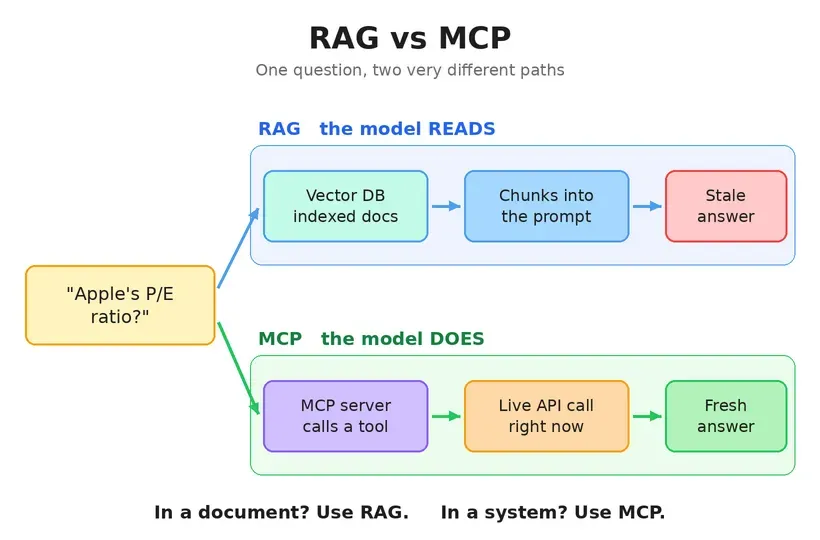
“What’s Apple’s current P/E ratio?”
Build that with RAG and you’ll get a confident, well-formatted, wrong answer. Build it with MCP and it works. Now change the question to and the situation flips: RAG handles it cleanly, and MCP has nothing useful to offer.
“explain how P/E ratios are calculated for companies with negative earnings”
Same domain. Same user. Completely different architecture.
Most of the confusion around RAG and MCP comes from treating them as two options on a menu. They aren’t. Once you see what each one actually is, the choice stops being a judgment call and becomes almost mechanical.
This article walks through both concepts from first principles, builds the same financial assistant twice, and gives you a decision rule you can apply without thinking hard about it.
Part 1: What RAG actually is
RAG stands for Retrieval-Augmented Generation. Strip away the terminology and it’s three steps:
Retrieve the chunks of text most relevant to the user’s question.
Augment the prompt by pasting those chunks into it.
Generate an answer using that borrowed context.
The analogy that makes it click
Imagine an exam where you can’t bring notes, but you have a research assistant outside the room. You slide your question under the door. The assistant sprints to the library, finds the three most relevant pages, and slides them back. You write your answer using those pages.
You didn’t learn anything. You just got the right pages at the right moment.
That’s RAG. The model’s weights never change. You’re editing the prompt, not the model.
Why it needs a vector database
The hard part is step 1: finding the right pages. Keyword search fails constantly here, because human questions rarely use the same words as the source text.
Someone asks about “companies that lose money.” The document says “negative net income.” Zero keyword overlap, identical meaning.
Embeddings solve this. An embedding model converts text into a list of numbers (a vector) positioned in space so that similar meanings land near each other. “Companies that lose money” and “negative net income” end up as neighbors, even sharing no words.
A vector database stores these vectors and answers one question fast: what’s nearest to this?
RAG in code
Here’s a minimal, honest implementation. No framework, so you can see every moving part:
from openai import OpenAI
client = OpenAI()
# Your knowledge base, already chunked.
DOCUMENTS = [
    "The P/E ratio divides share price by earnings per share. "
    "When earnings are negative, P/E is undefined and usually shown as N/A.",
    "EV/EBITDA is often preferred over P/E for capital-intensive companies "
    "because it is unaffected by capital structure and depreciation policy.",
    "The PEG ratio adjusts P/E by the expected earnings growth rate. "
    "A PEG below 1.0 is traditionally read as undervalued.",
]

def embed(text: str) -> list[float]:
    """Turn text into a vector."""
    response = client.embeddings.create(
        model="text-embedding-3-small",
        input=text,
    )
    return response.data[0].embedding

def cosine_similarity(a: list[float], b: list[float]) -> float:
    """How close are two vectors? 1.0 means identical direction."""
    dot = sum(x * y for x, y in zip(a, b))
    norm_a = sum(x * x for x in a) ** 0.5
    norm_b = sum(y * y for y in b) ** 0.5
    return dot / (norm_a * norm_b)

# Index once, reuse many times. In production this lives in a vector DB.
INDEX = [(doc, embed(doc)) for doc in DOCUMENTS]

def retrieve(question: str, k: int = 2) -> list[str]:
    """Step 1: find the most relevant chunks."""
    q_vector = embed(question)
    scored = [
        (cosine_similarity(q_vector, vector), doc)
        for doc, vector in INDEX
    ]
    scored.sort(reverse=True)
    return [doc for _, doc in scored[:k]]

def answer(question: str) -> str:
    """Steps 2 and 3: augment the prompt, then generate."""
    context = "\n\n".join(retrieve(question))
    prompt = (
        f"Answer using only the context below.\n\n"
        f"Context:\n{context}\n\n"
        f"Question: {question}"
    )
    response = client.chat.completions.create(
        model="gpt-4o-mini",
        messages=[{"role": "user", "content": prompt}],
    )
    return response.choices[0].message.content

print(answer("What do I use when a company has negative earnings?"))
Notice what happened. The model was never trained on those three documents. It answered correctly because the right chunk landed in its prompt.
Notice also the ceiling: RAG can only return what you indexed. If Apple’s P/E changed this morning and your index was built last month, RAG will answer with last month’s number and sound completely certain about it.
That limitation is the entire reason MCP exists.
Part 2: What MCP actually is
MCP stands for Model Context Protocol. Anthropic introduced it in November 2024, and in December 2025 donated it to the Agentic AI Foundation under the Linux Foundation, which is why it’s now supported across Claude, ChatGPT, Gemini, Cursor, and VS Code rather than being one vendor’s format.
MCP is a standard for connecting AI models to tools. Not a technique. A protocol, in the same category as HTTP or SQL.
The analogy
Before USB-C, every device had its own connector. Fifteen devices meant fifteen incompatible cables, and every new device meant a new cable for every port.
That was AI tooling before MCP. Connecting 10 AI applications to 100 tools meant writing up to 1,000 custom integrations. Each one bespoke, each one maintained separately.
MCP collapses that to one shape. A tool provider implements the protocol once, and every MCP-compatible client can use it. The AI application implements the client side once, and gets access to everything.
The three things MCP servers expose
Tools are functions the model can call. get_stock_price("AAPL.US") runs real code and returns a real result.
Resources are data the model can read, like documentation or file contents.
Prompts are reusable templates that chain several tools into a complete workflow.
MCP in code
Here’s a working server. This is the whole thing:
from mcp.server.fastmcp import FastMCP
import httpx
mcp = FastMCP("finance-tools")

@mcp.tool()
def get_current_price(ticker: str) -> dict:
    """Get the latest price for a stock ticker.
    The docstring matters more than you'd think. It is what the
    model reads to decide whether to call this tool at all.
    """
    response = httpx.get(f"https://api.example.com/quote/{ticker}")
    return response.json()

@mcp.tool()
def compare_tickers(ticker_a: str, ticker_b: str) -> dict:
    """Compare two tickers on price, market cap and P/E ratio."""
    return {
        "a": get_current_price(ticker_a),
        "b": get_current_price(ticker_b),
    }

if __name__ == "__main__":
    mcp.run()
Connect it to Claude Code with one command:
claude mcp add finance -- python /path/to/server.py
Now the model can do things. It isn’t reading about prices. It’s fetching them.
One detail worth internalizing: the docstring is the interface. The model decides whether to call your tool based on that description. A vague docstring produces a tool that never gets used, which is the most common reason a correctly installed MCP server appears to do nothing.
Part 3: The actual difference
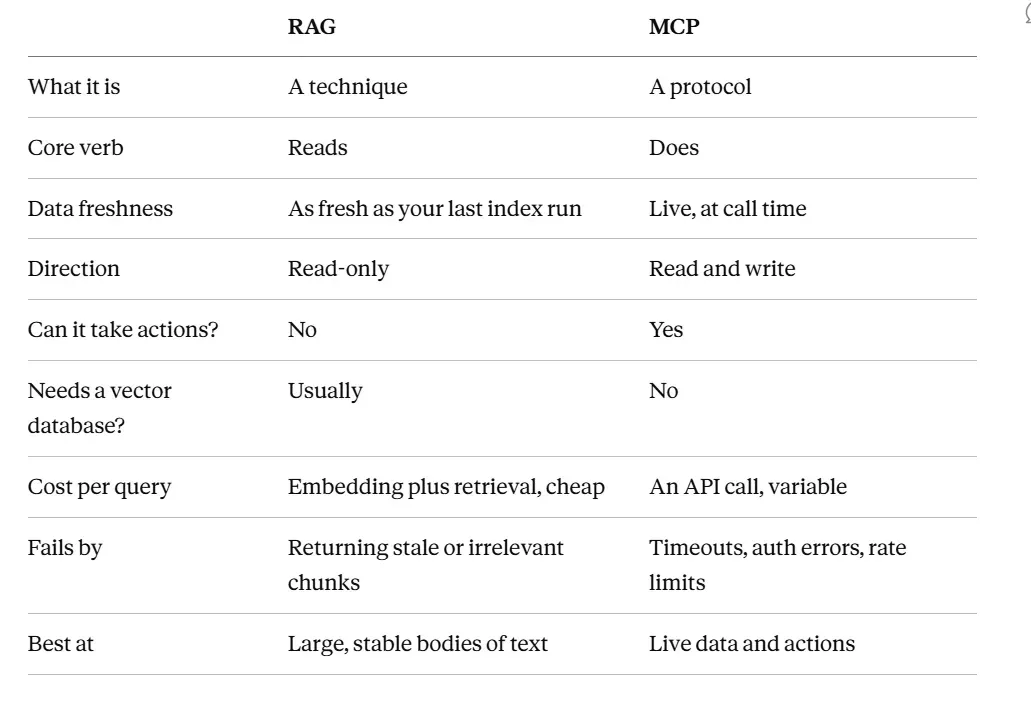
Here’s the comparison in one table:
The one-sentence rule
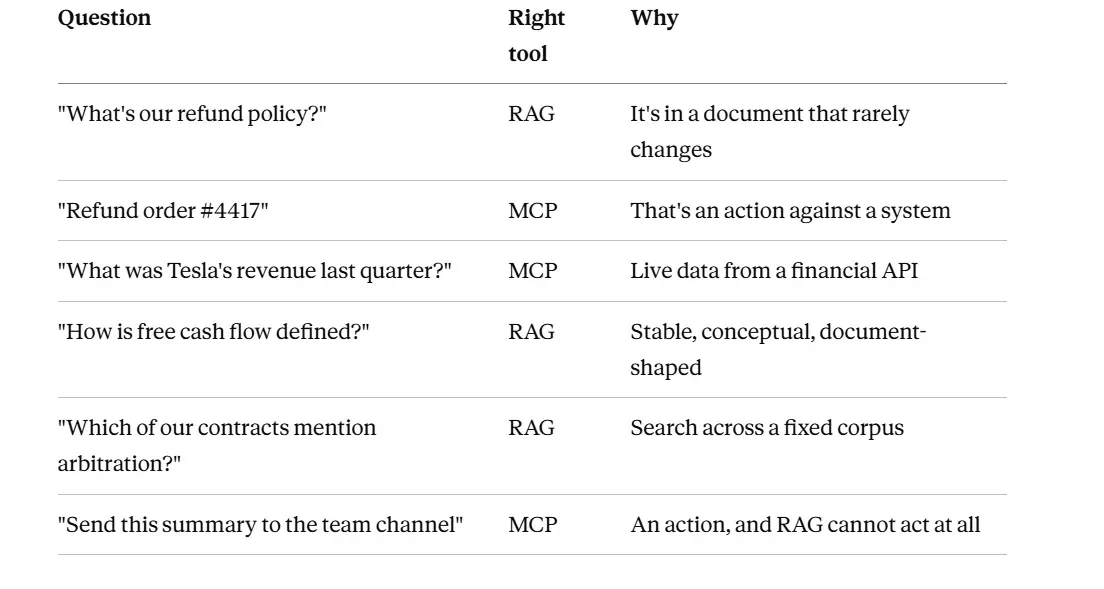
If the answer lives in a document, use RAG. If the answer lives in a system, use MCP.
Test it against real questions:
Why “is RAG and MCP the same?” keeps getting asked
Because of one overlapping case: an MCP server can expose documentation as a resource, which looks like retrieval.
The difference is scale and mechanism. MCP resources work well for a bounded set of documents the model can navigate by ID. RAG works when you have thousands of documents and need semantic ranking to find the relevant three.
They can also be composed. An MCP server can run a RAG pipeline internally and expose it as a search_knowledge_base tool. At that point the model calls a tool (MCP) that performs retrieval (RAG). Both, cooperating.
Part 4: The same assistant, built twice
Abstract comparisons only get you so far. Let’s build a financial analysis assistant both ways and watch where each breaks.
Financial data is the ideal test case because it contains both kinds of question in the same domain: definitions that never change, and numbers that change every second.
I’m using EODHD for market data here, because it happens to offer both a conventional REST API and an official MCP server, which makes it a clean way to compare the two architectures without changing data providers midway.
Version A: the RAG approach
Index a corpus of financial knowledge, then answer questions from it.
# Building a knowledge base of financial concepts
CORPUS = [
    "Market capitalization equals share price multiplied by shares outstanding.",
    "The P/E ratio compares share price to earnings per share.",
    "Free cash flow is operating cash flow minus capital expenditures.",
    "A dividend yield above 6% often signals either a falling share price "
    "or an unsustainable payout ratio.",
    # ...plus a few thousand more chunks
]
# Index them, then:
answer("Explain what a high dividend yield might indicate")
This works well. The concept is stable, the answer is in the corpus, and retrieval finds it.
Now try this:
answer("What is Apple's current dividend yield?")
This fails, and it fails in the worst possible way. The model finds a chunk explaining what dividend yield means, notices it also absorbed an Apple figure during training, and produces something like “Apple’s dividend yield is approximately 0.5%.”
Confident. Well-formatted. Potentially months out of date. Nothing in the pipeline flags it.
That’s the RAG failure mode people underestimate. It doesn’t return an error. It returns fluent, stale text.
Version B: the MCP approach
Connect the model to live data instead.
# EODHD publishes two endpoints. v2 uses OAuth, v1 uses an API key.
claude mcp add --transport http eodhd https://mcp.eodhd.com/v2/mcp
Now the same question routes differently. The model calls resolve_ticker("Apple") to get AAPL.US, then get_fundamentals_data to pull the current figure. The number is real because it was fetched, not recalled.
Two design details in EODHD’s server are worth studying regardless of whether you use them, because they solve problems every tool-calling system hits:
Ticker resolution as a first-class tool. Users say “Apple,” APIs want AAPL.US. Users say "Deutsche Bank," the API wants DBK.XETRA. Their resolve_ticker tool handles names, partial tickers, and ISINs, and returns alternatives when a company trades on several exchanges instead of silently guessing wrong. Most tool-calling failures in financial agents happen at exactly this step.
Documentation embedded as resources. The server ships 100+ pages of its own API documentation as MCP resources, so the model can look up which parameters an endpoint accepts without spending an API call. This is the interesting part architecturally: it’s a small RAG-shaped pattern living inside an MCP server. Static reference material as resources, live data as tools, each doing what it’s good at.
Want to try the live-data half yourself?
EODHD’s MCP server exposes 72 read-only tools across 150,000+ tickers and 70+ exchanges, with a free plan that covers evaluation. It’s the fastest way to feel the difference between a retrieved answer and a fetched one. →Get a free EODHD API key
Version C: both, which is what you actually ship
Neither version alone is a good product. The RAG version can’t tell you today’s price. The MCP version burns an API call to explain what a P/E ratio is.
The real architecture routes by question type:
def route(question: str) -> str:
    """Decide which subsystem answers this question."""
# Signals that the question is about live state
    live_signals = ["current", "today", "now", "latest", "price", "quote"]
    if any(signal in question.lower() for signal in live_signals):
        return "mcp"      # fetch it
    return "rag"          # look it up
That keyword check is deliberately naive. In production the router is usually the model itself: you give it both the retrieval tool and the live-data tools, write clear descriptions, and let it choose. But the underlying logic is exactly this split.
The result:
“What’s the P/E ratio measuring?” → RAG, instant, near-zero cost
“What’s Microsoft’s P/E right now?” → MCP, live, one API call
“Is Microsoft’s P/E high for its sector?” → both: MCP for the number, RAG for the sector context that interprets it
That third question is where the combination earns its keep, and it’s also the shape of most real user questions.
Part 5: Related comparisons people conflate
The RAG-versus-MCP confusion tends to travel with three others. Clearing them up is quick.
MCP vs API
An MCP server is usually a wrapper around an API, not a replacement for it.
The difference is who the interface is designed for. A REST API is designed for a developer who reads documentation and writes integration code. An MCP server is designed for a model that discovers available tools at runtime and reads descriptions to decide what to call.
You still need the API underneath. MCP standardizes how a model discovers and calls it.
Use the API directly when you’re writing deterministic application code. Use MCP when a model needs to decide, at runtime, which operation to perform.
MCP vs agent
These sit at different layers, so comparing them is a category error.
An agent is the thing that reasons, plans, and decides. MCP is how the agent reaches the outside world.
An agent without MCP can think but not act. MCP without an agent is a server nobody is calling. Claude Code is the agent; the MCP servers are its hands.
RAG vs fine-tuning
Both change what a model can do, in different ways.
Fine-tuning adjusts the model’s weights. It teaches behavior: tone, format, domain-specific style, consistent structure. It’s expensive, slow to iterate, and updating knowledge means retraining.
RAG leaves weights untouched and changes the prompt. It teaches facts. Updating means re-indexing a document, which takes seconds.
The practical rule: fine-tune for how the model should behave, use RAG for what it should know. If your answer changes when a document changes, that’s RAG. If your answer changes when your style guide changes, that might be fine-tuning.
Part 6: Choosing your stack
If you’re building either half, here’s the landscape as it stands in 2026.
For the RAG half, you need a vector database. Qdrant is the one I reach for most, partly because it self-hosts cleanly in Docker and partly because it ships an official MCP server, which means the same index is reachable from a script or from Claude Code. Chroma is the gentlest starting point if you want something running in five minutes with no infrastructure. Weaviate and Pinecone round out the serious options, the latter fully managed if you’d rather not run anything.
For the orchestration layer, LlamaIndex remains the most focused framework for the retrieval-and-indexing problem specifically, while LangChain is broader and heavier.
For the MCP half, Composio routes many applications through a single endpoint with just-in-time tool loading, which directly addresses the context-bloat problem that comes from connecting a dozen servers. Arcade.dev takes the authentication problem seriously, injecting OAuth tokens into tool execution without exposing them to the model, which matters as soon as more than one user is involved. Mem0 sits interestingly between the two categories: it’s an MCP server whose job is semantic memory, which is to say retrieval.
For observability, once both halves are running you’ll want to see which retrieval calls returned garbage and which tool calls failed. Langfuse is open source and self-hostable for that.
The pattern worth noticing: several of these companies now ship an MCP server for a product that is fundamentally about retrieval. The two ideas are converging in practice, not competing.
FAQs
❓ Is RAG the same as MCP?
✅ No. RAG is a technique for injecting retrieved text into a prompt so the model can read it. MCP is a protocol for letting a model call tools and take actions. RAG makes a model better informed; MCP makes it capable. They operate at different layers and are frequently used together in the same application.
❓ Does MCP replace RAG?
✅ No, and the framing causes real architectural mistakes. MCP is a transport standard for tool calling. If you have 50,000 documents to search semantically, you still need embeddings, a vector database, and a retrieval pipeline. What MCP changes is how the model reaches that pipeline: instead of a custom integration, you expose it as a tool through a standard interface.
❓ When should I use RAG instead of MCP?
✅ When the answer lives in a large, relatively stable body of text: documentation, contracts, policies, research papers, support articles. RAG is cheaper per query and returns faster than an API round trip. Switch to MCP the moment the answer depends on current state, or the moment the user wants something done rather than explained.
❓ What is the difference between MCP and an API?
✅ An MCP server almost always wraps an API. The API is the underlying capability; MCP is the standardized way a model discovers and invokes it. APIs are designed for developers reading documentation at build time. MCP is designed for models reading tool descriptions at runtime. You use the API directly in deterministic code, and MCP when the model needs to choose.
❓ Do I need a vector database for MCP?
✅ No. MCP has no retrieval component of its own. Vector databases belong to RAG. You’d only bring one into an MCP setup if the tool you’re exposing happens to perform semantic search, in which case the vector database sits behind the tool rather than beside it.
❓ Can an MCP server run RAG internally?
✅ Yes, and this is a common production pattern. You build a normal retrieval pipeline, then expose it as a single tool such as search_internal_docs. The model calls one tool; behind it, embedding and vector search do the work. The model doesn't need to know the difference.
❓ Which is cheaper to run?
✅ RAG is usually cheaper per query once indexed, since you pay for a small embedding call plus a vector lookup. MCP costs whatever the underlying API costs, which can vary a lot: a stock quote is cheap, a browser session or a document-processing call is not. The expensive failure mode is using MCP for questions RAG could have answered from a static index.
❓ What about MCP vs A2A?
✅ Different problems. MCP connects a model to tools. A2A (Agent-to-Agent) is about agents communicating with other agents. An agent might use MCP to call a database and A2A to hand work to a specialist agent. They’re complementary layers, not alternatives.
❓ How do I decide quickly which one I need?
✅ Ask whether the answer would change if you re-ran the query in an hour. If yes, it’s live state, so MCP. If no, it’s stable knowledge, so RAG. Then ask whether the user wants something to happen. If yes, it’s MCP regardless, because RAG cannot act on anything.
The reason this comparison keeps circulating is that both technologies got popular around the same time and both are described with the phrase “gives your AI access to your data.”
That description is doing too much work. Access to read what you wrote is a different problem from access to do things in your systems.
Get the split right and the architecture mostly designs itself.
Building something with financial data?
EODHD covers 150,000+ tickers across 70+ exchanges, with both a REST API and an official MCP server, so you can test either architecture without switching providers. →Start with the free plan
Need technical content that explains hard concepts clearly?
I write developer-focused tutorials and comparisons with working code and honest trade-offs. →See my work and get in touch