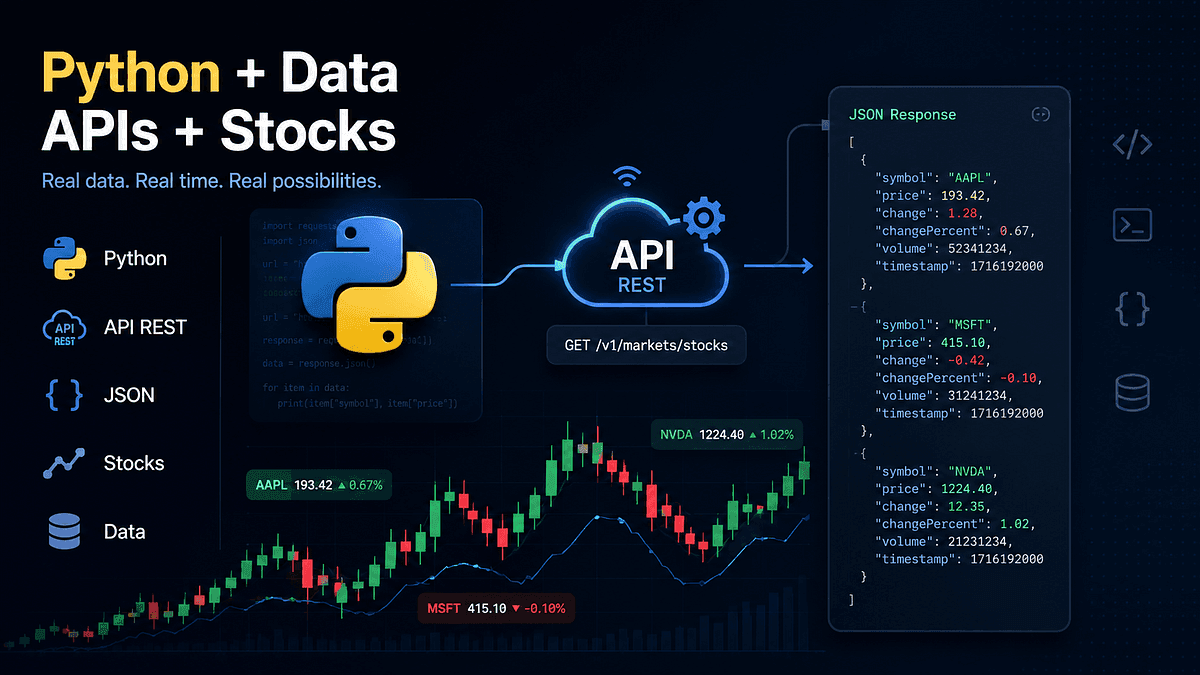
Originally published on medium.com

TL;DR: Scraping and unofficial wrappers like yfinance break in production. For Python projects that need historical + real-time stock data without stitching together multiple providers, EODHD offers the widest coverage (150,000+ tickers, 70+ exchanges) under one API key. Massive is a strong alternative for low-latency US real-time feeds, Alpha Vantage works for prototyping, and yfinance should stay limited to personal scripts.
Many developers believe you need to pay hundreds of dollars a month for reliable stock market data in Python. That’s not true.
The real problem isn’t price. It’s picking the wrong API before you know what production actually demands.
If you’re:
This decision will follow you for months. Get it wrong, and you rebuild the whole data layer later.
Most Python developers start the same way. yfinance, a scraping script, maybe an unofficial endpoint someone shared on GitHub.
It works. In local testing.
Then it hits production.
Rate limits appear out of nowhere. Endpoints change without warning. A field that returned a float last month now returns a string. Your script that ran perfectly on Tuesday throws a KeyError on Wednesday.
Developers often discover this too late — after building an entire pipeline around a source that was never meant to be an API in the first place.
The symptoms are always the same:
None of this is a coding problem. It’s an infrastructure problem.
Stock data itself isn’t scarce. Every exchange publishes it.
The real problem is structure: getting that data through a stable, documented, rate-limit-transparent REST API instead of a scraper held together with try/except blocks.
Before picking any stock market API for a Python project, check for four things:
After testing multiple providers for backtesting and screener projects, I consistently reach for EODHD for this type of work. Here’s why.
EODHD covers over 150,000 tickers across 70+ exchanges, with end-of-day, intraday, and real-time endpoints under one API key. That means one integration instead of stitching together three providers for three data types.
If you’re a software or API company looking to explain your product through high-quality educational content (not marketing fluff), feel free to connect with me on LinkedIn.
Let’s pull historical daily prices for a single ticker.
pip install requests pandas
import requests
import pandas as pd
API_TOKEN = "your_api_token"
symbol = "AAPL.US"
url = f"https://eodhd.com/api/eod/{symbol}"
params = {
"api_token": API_TOKEN,
"fmt": "json",
"period": "d"
}
response = requests.get(url, params=params)
data = response.json()
df = pd.DataFrame(data)
df["date"] = pd.to_datetime(df["date"])
print(df[["date", "open", "high", "low", "close", "volume"]].tail())
Output:
date open high low close volume
495 2026-06-24 198.31 200.12 197.85 199.40 48213500
496 2026-06-25 199.50 201.03 198.90 200.77 39871200
497 2026-06-26 200.90 202.44 199.75 201.15 41205300
498 2026-06-29 201.20 203.01 200.44 202.63 36994800
499 2026-06-30 202.70 204.15 201.98 203.29 44012700
From here you can build:
No scraper to maintain. No parsing HTML. Just a request and a DataFrame.
Covers historical, real-time, and fundamental data across global exchanges through a single REST API.
Pros
Cons
Best for: developers who need historical + real-time + fundamentals without juggling three providers.
A free-tier-first API popular for quick prototypes and learning projects.
Pros
Cons
Best for: early-stage prototypes and academic projects, not production systems.
Focused heavily on US equities and options with fast real-time feeds.
Pros
Cons
Best for: US-focused trading applications that need speed over breadth (formerly Polygon.io, now rebranded as Massive).
An unofficial wrapper around Yahoo Finance’s internal endpoints.
Pros
Cons
Best for: personal scripts and one-off analysis, never production systems.
If you’re testing an idea over a weekend, yfinance Is fine.
The moment that idea becomes a screener, a dashboard, or anything a client depends on, move to a documented REST API.
EODHD covers the widest range of use cases — historical, real-time, and fundamentals — without forcing you to combine multiple providers just to cover the basics.
❓ Is there a free stock market API for Python?
✅ Yes. EODHD, Alpha Vantage, and yfinance all offer free access. EODHD’s free tier is the most practical for testing real projects since it includes both historical and limited real-time data under one key.
❓ What's the best stock API for real-time data?
✅ For US-only real-time feeds, Massive is strong. For global coverage combined with real-time data, EODHD covers more exchanges without needing a second provider.
❓ Can I use yfinance in a production app?
✅ Not recommended. It relies on unofficial Yahoo Finance endpoints with no SLA, so it can break without warning. Use it for prototypes only.
👉 Get started with EODHD here
You'll get access to:
The real question isn't which API has the most features. It's the one you can still trust in six months.
Looking for technical content for your company? I can help — LinkedIn · kevinmenesesgonzalez@gmail.com