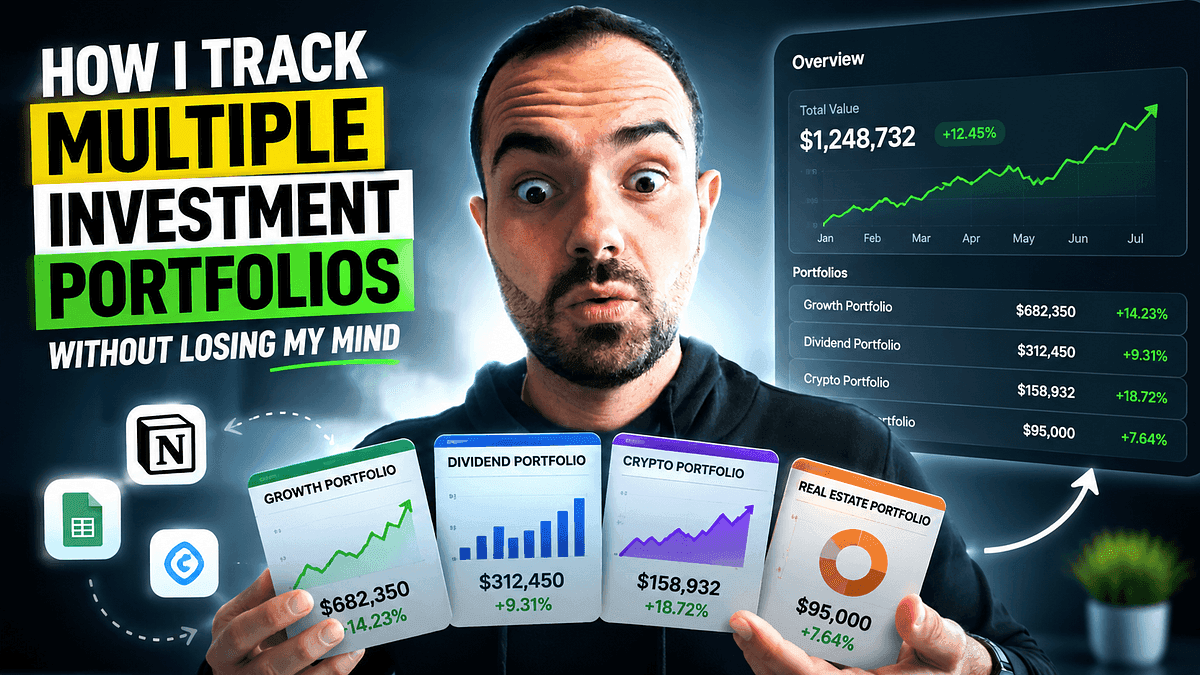
I used to have one account doing three jobs at once: my emergency fund, my retirement money, and my speculative bets — all sitting in the same portfolio view, all judged by the same number.
That number was almost always wrong to react to.
If you’re:
building a retirement portfolio alongside a smaller speculative one,
keeping an emergency fund invested instead of sitting in cash,
or just tired of one bad ticker making your whole net worth feel shaky,
this matters more than it looks.
One Portfolio, Three Different Jobs
Most investors don’t start with a plan. They start with an account.
You open a broker, you buy something. Then you buy something else. Over time the account fills up with positions that were never meant to serve the same purpose — a boring dividend ETF sitting right next to a speculative small-cap you bought on a whim.
The broker doesn’t care. To the app, it’s all just “your portfolio.” One total value. One percentage change. One color, red or green.
But your money isn’t one thing. It has jobs.
The Real Problem: Mixing Purpose With Capital
Here’s what mixing everything into one view actually costs you.
Say your speculative position drops 25% in a bad week. If it only represents 8% of your total capital, that’s a manageable, expected outcome of holding something risky.
But if your dashboard only shows total portfolio value, that 25% drop on a small slice reads as “my net worth just took a hit” — because you can’t see that the other 92% of your money, sitting safely in retirement-focused positions, didn’t move.
The problem isn’t that you own risky positions. It’s that you can’t see how much of your capital is actually exposed to that risk.
This is exactly how good investors end up making bad decisions — their strategy wasn’t wrong, their view of it was incomplete
Why One Global Number Isn’t Enough
A single portfolio value answers one question: how much money do you have today.
It doesn’t answer the questions that actually drive good decisions:
Is my emergency fund liquid enough if I need it in 30 days?
Is my retirement allocation still on track, independent of what my speculative bets are doing?
How much of my total risk is coming from the 10% of capital I’ve set aside to take real chances?
Without segmentation, every decision gets made against the wrong backdrop. You end up being too conservative with money that could handle risk, and too exposed in money that can’t.
What Segmented Tracking Actually Looks Like
Related articles
I moved to tracking three separate portfolios inside Snowball Analytics, each with its own purpose:
Emergency fund — low-volatility positions, tracked for liquidity and stability, not growth
Retirement — long-term ETFs and dividend growers, tracked for allocation drift and long-term performance
Speculative — individual high-risk positions, tracked in isolation so a bad week there doesn’t distort my read on everything else
Each portfolio gets its own allocation chart, its own performance number, its own risk profile — while Snowball still shows me the consolidated net worth across all of them when I want the full picture.
That distinction is the whole point: you get to zoom in or zoom out, on purpose, instead of only ever seeing the blended average.
Stop Mixing Purpose With Capital
Track your emergency fund, retirement, and speculative positions separately — with one consolidated view when you need it. →Start your free trial with Snowball Analytics
A Concrete Example: The Speculative Bet That Wasn’t a Crisis
In early 2026, I bought into a small AI-adjacent stock as a pure speculative position — I knew going in it could drop hard.
It did. Down close to 30% in six weeks.
Before segmenting my portfolios, a drop like that would have shown up as a dent in my overall net worth, sitting right next to my retirement allocation, making the whole picture look worse than it was.
With the positions separated, I could see exactly what that 30% drop meant: a 2.1% impact on my total net worth, contained entirely inside the portfolio I’d built specifically to absorb that kind of risk.
Retirement allocation: unaffected. Emergency fund: unaffected. Decision: hold, because the position was doing exactly what a speculative bet is supposed to do — take risk with money set aside for exactly that.
That clarity doesn’t come from discipline. It comes from being able to actually see the split.
A Second Example: The Emergency Fund You Didn’t Know Was Underperforming
Segmentation cuts both ways: it contains risk, and it also catches money that’s quietly not doing its job.
I kept my emergency fund inside a mix of short-term bond ETFs and cash equivalents, assuming it was “safe and stable.” Once tracked as its own portfolio, the numbers told a different story: it was barely keeping pace with inflation, sitting at a real return close to zero over 18 months.
Blended into my total net worth, that underperformance was invisible — masked by gains elsewhere. Isolated as its own portfolio, it became obvious, and I could act on it (moving part of it into a slightly higher-yield instrument without touching its liquidity requirement).
You can’t fix what you can’t see separately.
Common Mistakes When Managing Multiple Portfolios
1. Using account structure as a proxy for purpose.
Having money in Degiro and money in Trade Republic doesn’t mean you have two purposeful portfolios — it just means you have two accounts. Purpose has to be defined by goal, not by which broker holds the position.
2. Rebalancing everything against the same target allocation.
A 60/40 target makes sense for a retirement portfolio. It makes no sense applied to an emergency fund, which should prioritize liquidity and stability over any specific stock/bond split.
3. Letting the speculative portfolio grow past its intended size.
It’s easy to keep adding to a position that’s working. If your “small speculative bet” quietly grows to 25% of your net worth because it did well, it stops being a contained experiment and starts being a real risk to your whole plan.
4. Checking the emergency fund’s performance instead of its liquidity.
The emergency fund’s job is availability when you need it, not maximum return. Judging it by the same performance lens as your retirement portfolio leads to bad decisions — like locking it into something less accessible for a marginally better yield.
5. Never revisiting the split as life changes.
The right proportions between these three portfolios when you’re 28 and renting are not the right proportions at 40 with a mortgage and kids. Segmentation only helps if you periodically revisit whether the split still matches your actual situation.
Practical Tips for Setting This Up
Define the job before you define the allocation. Ask “what is this money for” before deciding what to put in it — the answer determines whether you optimize for liquidity, growth, or risk tolerance.
Set a hard ceiling on your speculative portfolio as a percentage of net worth. Decide the number in advance — 5%, 10%, whatever fits your risk tolerance — and treat any growth past that ceiling as a signal to trim back, not a reason to celebrate.
Track your emergency fund against inflation, not against the market. Its benchmark is inflation, not the S&P 500 — the real question is whether it’s preserving purchasing power while staying liquid.
Review each portfolio on a different schedule. Check the speculative portfolio as often as you like — it’s designed to be watched. Check retirement quarterly. Check the emergency fund twice a year, mostly to confirm it’s still liquid and roughly keeping pace with inflation.
Look at the consolidated view before making any big life decision. Segmentation is for day-to-day clarity. Big decisions — buying a house, changing jobs — need the full picture, not just one slice of it.
Three Things to Take Away
One portfolio number hides three different jobs your money is doing. Segmenting by purpose, not by broker, is what actually clarifies decision-making.
A bad week in your speculative portfolio isn’t a crisis if you can see it’s contained. Isolation prevents panic that isn’t warranted.
Segmentation also catches underperformance that a blended view hides — like an emergency fund quietly losing to inflation.
FAQs
❓ Should I use separate broker accounts for each portfolio goal, or just track them separately?
✅ You don’t need separate brokers — you need separate tracking. Tools like Snowball Analytics let you tag or group positions by goal within a single consolidated dashboard, so you get isolated views without fragmenting where your money actually sits.
❓ How much should I allocate to a speculative portfolio?
✅ There’s no universal number, but most investors who use this approach cap it somewhere between 5% and 15% of total net worth — enough to take real risk, small enough that a bad outcome doesn’t threaten the rest of the plan.
❓ Should my emergency fund be invested at all?
✅ Part of it can be, in low-volatility, highly liquid instruments — but the priority is always availability over return. If accessing it quickly would ever be a problem, it’s in the wrong place, regardless of yield.
Your money already has different jobs.
The only question is whether you can actually see them separately — or whether you’re still judging all three by the same blended number.
See Every Portfolio Clearly — Without Losing the Big Picture
Snowball Analytics lets you:
Separate your retirement, em
emergency fund, and speculative positions into their own tracked portfolios
Set a different benchmark and review cadence for each one
See your full consolidated net worth whenever you need it
Need Content Like This for Your Fintech or Investing Product?
I write technical, non-fluff articles that developers and investors actually want to read. →See my work