Ai Voice AgentAI AgentEleven LabsAPIVoice Assistant
Every “best voice AI API” article in 2026 says the same five names.
Vapi. Retell. Bland. ElevenLabs. Deepgram.
That’s not because they’re the only good options. It’s because those companies write most of the comparison articles themselves.
If you’re:
building a voice agent on a tight budget,
looking for lower latency than the big names offer,
or just tired of reading the same five names ranked in a different order,
these five are worth your attention.
The Comparison Articles Are Written by the Competitors
Search “Vapi alternatives” and you’ll land on an article published by Retell. Search “Retell vs Vapi” and the top result is written by Bland.
Each one ranks itself first, for obvious reasons.
That’s not dishonest exactly. It’s just not neutral. And it means the smaller players — the ones actually competing on price and latency, not marketing budget — rarely surface.
The Real Gap Isn’t Options. It’s Visibility
There’s no shortage of voice AI infrastructure in 2026.
The problem is that the interesting names are buried under SEO built by the five companies with the biggest ad budgets.
Some of the smaller players below already beat the incumbents on the metrics that matter — latency, price per minute, or specialization. One of them is currently ranked #1 on a neutral third-party benchmark.
Rime builds text-to-speech, not full orchestration. That’s the point — it does one thing and does it fast.
Founded by a Stanford NLP researcher, a linguist who spent years on the Alexa team, and a Stanford engineer, Rime’s positioning is different from the rest of this list: linguistics first, infrastructure second.
Pros
Mist v3 hits roughly 37ms P50 latency on H100 hardware — faster than Cartesia and Deepgram on raw TTS benchmarks
Self-hosting available for compliance-heavy deployments
600+ voices with fine control over accent, pace, and tone across 50+ languages
Cons
TTS only — you still need a separate STT and orchestration layer
Smaller voice library than ElevenLabs for creative/branded use cases
Best for: teams that already have their own orchestration layer and just need the fastest TTS component available.
Bolna goes after the same use case as Vapi or Retell — a full voice agent, not just a TTS or STT layer — but prices itself for small merchants, not enterprises.
Pros
Starts at $9.99/month plus $0.10/minute, with 100 free inbound minutes on the base plan
Live in minutes using pre-built agent templates, no custom pipeline required
Built-in call transcripts, recordings, and summaries without extra configuration
Cons
Templates limit how far you can customize conversation logic compared to Vapi’s raw API access
Smaller ecosystem of integrations than the bigger platforms
Best for: solo developers or small businesses that want a working phone agent this week, not a six-week integration project.
Smallest.ai splits its product into two pieces: Waves, a neural TTS engine with emotional range, and Atoms, plug-and-play voice agents for IVR and support flows.
Pros
Modular architecture lets you use just the TTS engine or the full agent layer
Built specifically around real-time voice with deep LLM alignment, not retrofitted onto an older text bot
Positioned directly as a lower-cost, more flexible alternative to Vapi’s orchestration model
Cons
Less third-party benchmark data available than Rime or Inworld
Younger platform — fewer large-scale production case studies to point to
Best for: developers who want Vapi-style flexibility without committing to Vapi’s pricing or vendor lock-in.
Lemonfox covers both TTS and STT, and its entire pitch is developer-first pricing without the premium markup that ElevenLabs charges for similar voice quality.
Pros
Meaningfully cheaper than ElevenLabs at comparable quality tiers
Handles both TTS and STT under one API, reducing vendor sprawl
Privacy-focused positioning, relevant if you’re handling sensitive audio data
Cons
Smaller voice catalog than ElevenLabs or Rime
Less name recognition means less community documentation to lean on
Best for: cost-sensitive projects that need solid TTS/STT quality without ElevenLabs-tier pricing.
How These Fit Together
None of these compete head-to-head on every axis. Pick based on which layer you’re missing:
Need just TTS, fast: Rime
Need the entire pipeline in one API: Inworld
Need a working agent today, cheap: Bolna
Need Vapi-style modularity, less lock-in: Smallest.ai
Need TTS/STT without ElevenLabs pricing: Lemonfox.ai
If you’re building for production and compliance matters, verify SOC2/HIPAA status directly with the vendor before committing — some cover it by default, others gate it behind an enterprise tier.
If you’re building voice infrastructure and want a second opinion on your stack before committing to a vendor, feel free to connect — I write about this kind of build regularly.
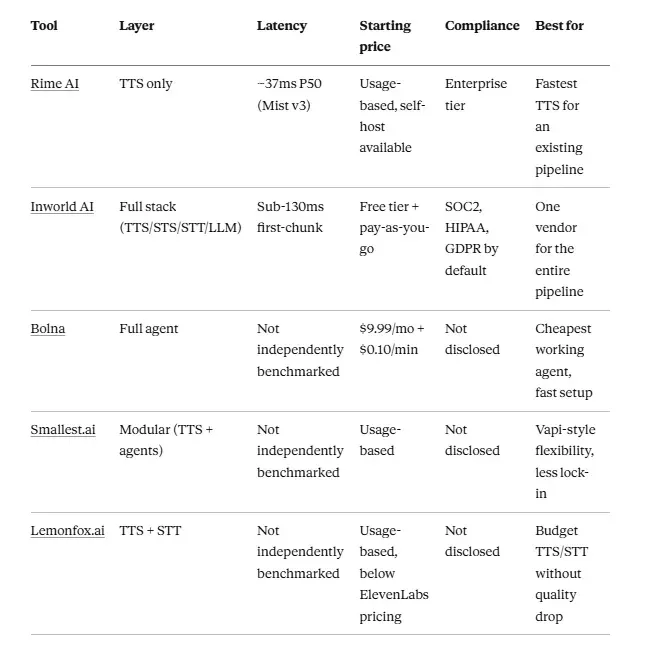
Comparison Table
Compliance and latency numbers change fast in this category — confirm current figures directly with each vendor before making a production decision.
Key Takeaways
The most-recommended voice AI APIs are recommended partly because they write the recommendation articles
Inworld currently outranks the household names on a neutral third-party benchmark, and it’s rarely mentioned
Match the tool to the layer you’re missing (TTS, STT, or full orchestration) instead of defaulting to whichever platform has the biggest marketing budget
FAQs
❓ Are these smaller voice AI APIs actually production-ready?
✅ Yes, with caveats per platform. Inworld ships SOC2/HIPAA/GDPR compliance by default and is used in production voice pipelines today. Rime and Lemonfox are production-grade for the TTS/STT layer specifically. Bolna and Smallest.ai are newer at the full-agent layer, so run a pilot before committing to high call volumes.
❓ Do these compete on price with Vapi or ElevenLabs?
✅ Generally yes, and that’s the main reason to consider them. Bolna starts under $10/month plus per-minute costs, well below Vapi’s effective stack cost. Lemonfox positions explicitly against ElevenLabs on price for comparable voice quality.
❓ Do any of these have SOC2 or HIPAA compliance?
✅ Inworld includes SOC2 Type II, HIPAA, and GDPR compliance across its plans. For the others, compliance tiers vary — always confirm directly with the vendor and request a signed agreement before handling real patient or customer data.